
Saver’s Credit, officially the Retirement Savings Contributions Credit, is a tax credit for people with low or moderate income who contribute to retirement accounts or ABLE accounts. 2026 is the last year it will apply to retirement accounts. Saver’s Match replaces it in 2027. Ironically, retirees with a part-time job or self-employment have a better chance of getting these than the working class.
Not as Effective as It Sounds
Saver’s Credit was enacted in 2001 together with the first Bush tax cuts. It gives politicians cover to say they did something for the working class while doing little. According to a report by the Congressional Research Service, only 5.7% of taxpayers received the Saver’s Credit in one year, and the average credit was only $191. It isn’t as effective at encouraging retirement savings as it sounds for several reasons.
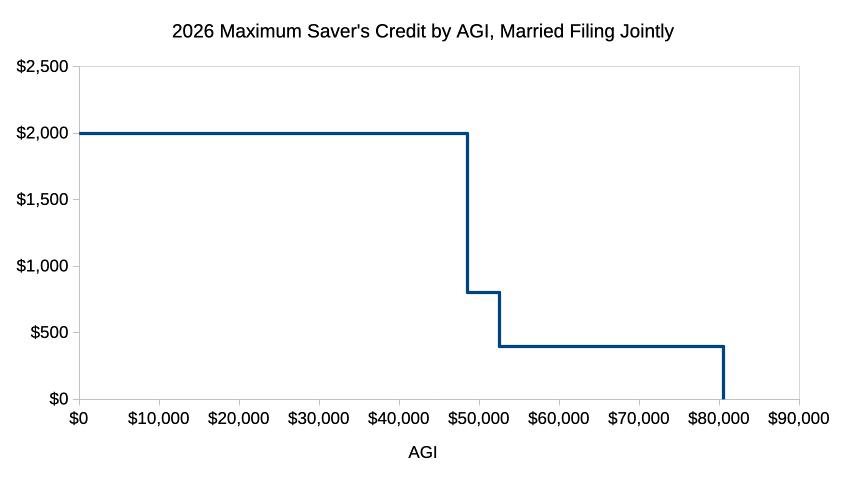
The chart above shows the maximum Saver’s Credit by AGI in 2026 for married filing jointly. Both the maximum credit and the AGI thresholds are halved for singles.
The maximum Saver’s Credit is $1,000 per person when someone saves $2,000 or more. The 2026 AGI cutoffs for the maximum credit are $24,250 for singles and $48,500 for married filing jointly. It’s hard to save $2,000 per person for retirement when people earn this much working full-time. Many low-wage workers forgo the employer match, let alone an after-the-fact tax credit (see Who’s Leaving 401k Match On the Table?).
The Saver’s Credit is non-refundable, meaning it can’t exceed the total tax. After the standard deduction, a single person with a $24,250 AGI pays less than $1,000 in total federal income tax. This person can never receive the full $1,000 Saver’s Credit.
If people receive the Saver’s Credit at all, they most likely fall into the last band (10% credit). The 2026 AGI cutoffs extend to $40,250 for singles and $80,500 for married filing jointly, which makes it more realistic to save $2,000 per person for retirement. However, the maximum Saver’s Credit also drops to $200 per person, far from the headline “up to $1,000 per person.”
Retirees Who Work a Little
Ironically, retirees who work part-time have a better chance of getting the Saver’s Credit than younger workers, because not all retirees’ income counts toward the AGI.
Part of Social Security isn’t taxable. A married couple with $55,000 from Social Security and $30,000 from other income has an AGI of $47,475. Their total federal income tax is $1,528 if they’re both under 65. They can contribute $2,000 per person to their IRAs if they have at least $4,000 in earned income from a part-time job or self-employment. The Saver’s Credit will reduce their federal income tax to zero.
The principal portion of taxable investments isn’t taxable. Selling $50,000 worth of investments with $10,000 of unrealized gains adds only $10,000 to the AGI. If a retired couple also has $40,000 from rental income and a part-time job, they have $90,000 available but only $50,000 in AGI. Their total federal income tax is $780 when both of them are under 65. They can contribute $2,000 per person to their IRAs if they have at least $4,000 in earned income. They will be eligible for the Saver’s Credit, which wipes out their federal income tax.
Distributions from retirement accounts (excluding Roth conversions) in the two previous years plus the current year and through the tax filing deadline count against net retirement account contributions. So, for the most part, only retirees who haven’t started withdrawing from retirement accounts yet will qualify.
If you’re in this situation — retired but working a little, not withdrawing from retirement accounts yet — you can use my tax calculator for retirees to check your AGI and your total federal income tax. If your AGI is under $40,250 for single or $80,500 for married filing jointly in 2026, and your total tax isn’t already zero, you can contribute $2,000 per person to a retirement account before April 15, 2027 and qualify for the Saver’s Credit. The tax calculator doesn’t show the Saver’s Credit because it doesn’t ask you about retirement account contributions. The AGI calculation is still correct.
Saver’s Match
2026 will be the last year for retirement account contributions to count toward the Saver’s Credit. Only ABLE accounts count starting in 2027.
Saver’s Match replaces Saver’s Credit for retirement account contributions in 2027. Instead of a tax credit, Saver’s Match goes into a retirement account you designate. It’s even more difficult to qualify for on income than Saver’s Credit.
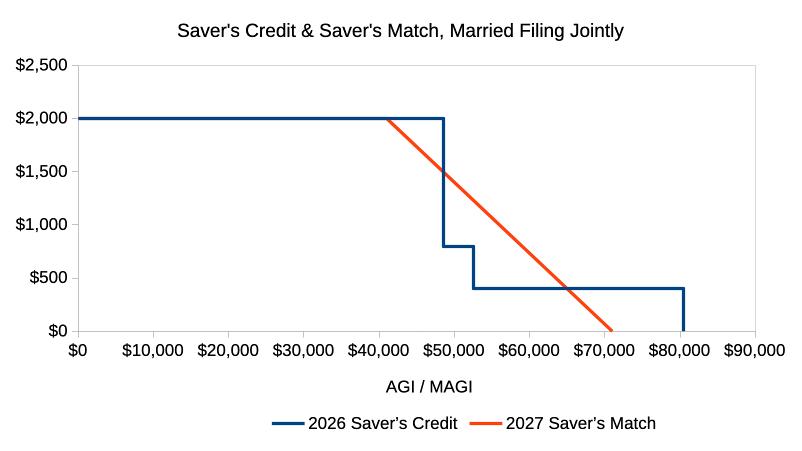
The chart above compares Saver’s Match in 2027 with Saver’s Credit in 2026 for a married couple contributing $2,000 to each of their IRAs. The blue line is the Saver’s Credit in 2026. The red line is the Saver’s Match in 2027.
The income eligibility is tighter. A married couple can qualify for a $400 Saver’s Credit with an AGI of $80,500 in 2026. Their 2027 income must be $41,000 or less for a full 50% match and under $71,000 for a phased-out match. If you do qualify, the match can be higher than the Saver’s Credit.
The income definition has also changed. Saver’s Credit uses AGI. Pre-tax retirement account contributions can help you qualify for Saver’s Credit. Saver’s Match uses MAGI, which adds back pre-tax retirement account contributions. Your income must qualify before deducting any pre-tax retirement account contributions.
Saver’s Credit isn’t taxable. Saver’s Match is pre-tax. It goes into a Traditional account you designate when you file your taxes. The match isn’t capped by the total tax though. You will still get the match even if your total tax is already zero. This is especially helpful for people 65 or older with a higher standard deduction and the senior deduction. They can’t benefit as much from the Saver’s Credit, but their Saver’s Match won’t be affected by their higher deductions.
Again, if you fit the narrow eligibility profile in 2027 — retired but working a little, not withdrawing from retirement accounts yet — you can use my tax calculator for retirees to check your 2027 AGI. If it’s under $35,500 for single or $71,000 for married filing jointly, you can contribute $2,000 per person to an IRA and qualify for the Saver’s Match if you have at least that much in earned income. The closer your AGI is to the lower end of the phaseout range ($20,500 for single and $41,000 for married filing jointly), the higher your match percentage will be.
Reference
- IRS Form 8880 (Saver’s Credit)
- IRS Notice 2026-48 (Saver’s Match)
Learn the Nuts and Bolts
I put everything I use to manage my money in a book. My Financial Toolbox guides you to a clear course of action.
Leave a Reply