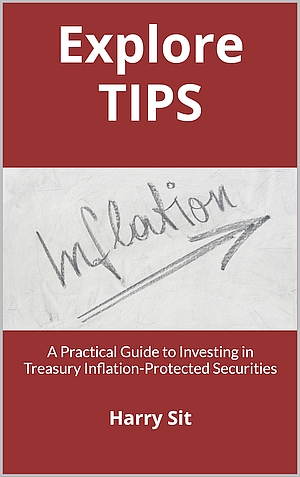
 Long-time readers know I have a special interest in TIPS, the inflation-indexed bonds. At one of my annual reader surveys, a reader asked why I wrote about TIPS all the time. I like TIPS because they have guaranteed inflation protection.
I wrote everything I know about TIPS into a book called Explore TIPS. I published the book this month.
The book is a practical guide to investing in TIPS. Everything in the book comes from my actual experience in investing in TIPS myself. It takes a beginner from knowing nothing about TIPS to knowing everything necessary for investing in TIPS. If you are a regular reader of this blog, you know my style. I leave no stone unturned. You won’t find this level of detail anywhere else. Please click here for a detailed table of contents.
The book is available at Amazon.com in both print and Kindle formats.
If you noticed I posted less frequently to this blog in the last few months, it’s because I had been working on this book. I can tell you from this experience that writing a book is a lot of work. If I do it only for money, it’s totally not worth it. I wrote the book because I really want others to understand TIPS.
If you buy the book, thank you. I would also really appreciate it if you write an honest review on Amazon, whether you end up liking the book or not. If you read the book and you still have questions, let me know via my contact form or leave them in the comments. There’s always room to address the questions and comments in the next revision.
Learn the Nuts and Bolts
I put everything I use to manage my money in a book. My Financial Toolbox guides you to a clear course of action.
Investor Junkie says
“I leave no stone unturned.”
Do you discuss the measuring of the CPI-U? Without question, TIPs will beat the way the government measures inflation. The question is can you trust (for many reasons) it is accurate?
DS says
Congrats on the new book.
As someone who has decided that VG’s TIPS fund is the easiest way to invest in this asset class, I look forward to reading chapter 3 on funds and ETFs.
Do you address in the book, or have any thoughts on, whether the ETF (ticker: TIP) is a better way to invest in this asset because it is passively managed, than the active but low cost VG TIPS fund?
Thank you and keep up the great work.
simplesimon says
I’m looking forward to checking this book out. Buying through the BH Amazon link no less!
Harry Sit says
DS – Yes, the iShares ETF TIP is included in Chapter 3. It’s about the same as the Vanguard mutual fund.
Harry Sit says
Investor Junkie – I included the CPI-U being lower than the experienced inflation as a risk factor.
Wai Yip Tung says
Congratulations on your work! I’m sure this will be a really informative book without all those non-sense.
Still no real name on a published book? This baffles me.
Mike says
This seems like a contrarian sign; the masses tend to buy near the top and sell at the bottom So as soon as the masses are thinking TIPS are the way to go, pushed by books like this, expect them to tank. See, for example, the article at Vanguard https://personal.vanguard.com/us/insights/article/bear-flattening-bond-surprise-04012010 As they write “What about investing in Treasury Inflation-Protected Securities (TIPS)? For some, TIPS may appear to be a safe harbor given fears that global demand for commodities and growing federal deficits could spark inflation. But this strategy also has potential hazards, Mr. Volpert said.
TIPS are coming off a long rally that drove their yields significantly lower than those of nominal Treasury bonds. The difference between those yields—a key indicator of risk and relative liquidity—is now higher than the consensus forecast for inflation. To bring the yields back into alignment, prices of TIPS will need to fall and their yields to rise. In addition, inflation expectations are an important driver of TIPS’ performance. If the Fed raises rates and inflation expectations fall, TIPS can be expected to underperform nominal Treasuries.”
Harry Sit says
Mike – So you think TIPS are overvalued at this time. That’s fine. Market conditions change, sometimes very fast. When the prices fall and the yields rise, people still need to understand how TIPS work and be ready to take advantage of them.
Ted Valentine says
Long time reader, some time commenter. Just wanted to say congrats on the book.
Jehnavi says
The difference between those yields—a key indicator of risk and relative liquidity—is now higher than the consensus forecast for inflation. To bring the yields back into alignment, prices of TIPS will need to fall and their yields to rise. In addition, inflation expectations are an important driver of TIPS’ performance. If the Fed raises rates and inflation expectations fall, TIPS can be expected to underperform nominal Treasuries.
Darren soong says
Hi,
Just bought Explore TIPS in pdf. Is there a way to put in in my Kindle or ibooks so I can read it on my ipad?
Harry Sit says
Yes it’s possible to put the pdf on Kindle or iPad.
Jim says
In January of 2001 I invested $200,000 in CUSIP 9128276R8 (TIPS 10 year @ 3.5%) which closed last month. Can you tell me what the closing amount is?
Harry Sit says
@Jim – According to January 2011 Daily Index Ratios, the final index ratio for this bond was 1.25687. For every $1,000 in face amount you bought in 2001, you should’ve been paid $1,256.87 in principal, plus a final interest payment of $1,256.87 * 3.5% / 2 = $21.995. That’s a total of $1,278.865. You invested $200,000. They should’ve closed at $255,773.05.
Jim says
Thanks for the answer on the 200K TIPS return. Fidelity’s figure was $251,374 (the TIPS were not held as a mutual fund), about $4,400 less than your figure. Had I invested 200K in 10 year Treasury’s at 4%, according to Treasury Direct’s Growth Calculator (it didn’t have a 3.5% choice), the closing amount would have been $297,189.48 – 42K-plus more than the TIPS. Is the interest rate in TIPS compounded?
Finally, should I challenge Fidelity on their closing amount?
Final “finally”: What do you think of investing in energy (especially oil) mutual funds, considering the M. E. turmoil?
Harry Sit says
@Jim – $251,374 is the principal ($1,256.87 * 200 = $251,374). The interest is usually credited as a separate entry. Look for it, you should see it. I have TIPS at Fidelity. I never had any problems with their calculation. Interest on individual TIPS are paid out to you. They don’t compound unless you reinvest the interest into another TIPS.
Finally, I don’t speculate on sectors such as oil or energy.
Jim says
I cannot get my brain around this TIPS closing amount. If I may recount?
1. On 1/15/2001 I bought $200,000 in CUSIP 9128276R8 (TIPS 10 year @ 3.5%), through Fidelity. Ten years later the closing value was $251,374, according to Fidelity.
2. Today I went to the Bureau of Labor Statistics’ Consumer Price Index inflation calculator (data.bls.gov/cgi-bin/cpicalc.pl ). From 2000 to 2010 (I know the term isn’t 2001 to 2011, but it’s close enough) and it calculated that:
“$200,000 in 2000 has the same buying power as $253,259.00 in 2010”
In other words, my investment didn’t even keep up with inflation – and that’s without the 3.5%!
Why would anyone invest in TIPS?
Harry Sit says
@Jim – First did you find the $4,399 interest credited as a separate entry on Jan. 15, 2011? Go back to your statement for July 2010. You will find a similar entry there too. You received these payments every six months for 10 years. Those are your 3.5% interest, adjusted for inflation. Let’s not forget them. Meanwhile, your original principal was kept up with inflation. I went to the same calculator and chose 2001-2011, it said $200,000 in 2001 has the same buying power as $248,699.04 in 2011. I don’t know which months’ CPI numbers the calculator uses but the $251k number is close enough.
Jim says
Bingo!
Thank you very, very much. I don’t know why Fidelity couldn’t have explained it as clearly as you did. They tried, in two emails, but failed.
Again, thank you.
You’re on my favorites bar.
Jim
Andrew Brown says
I tried to purchase this book but was unable to download the PDF. Please help.
Thanks,
Harry Sit says
@Andrew Brown – Sorry about the trouble. I emailed the PDF to you.
Jimbo says
Are you still selling the Explore TIP book in PDF format?
If so, how much detail do you go into with regards to purchasing TIPS on the secondary market?
Now that some of the TIPS with maturity dates of less than 10 years have positive yields again, I’m starting to purchase them. But, I’ve got to admit I’m confused about a few things.
For example, I purchased one whole bond thru Fidelity for what they call a limit price of $108.32. Factoring all of the other TIPS inanity in it cost $1,172.67 for the $1,000 bond. At that price, it has a whopping yield to maturity of .093%.
After purchasing the bond, I started to have second thoughts about the wisdom of making the purchase a such a premium price. Since the yield to maturity is positive, I should marginally break-even on the deal when interest payments are taken into consideration.
But, then it dawned on me. What if for some reason inflation was actually negative for long enough to revert below the inflation factor on the original issue? ? Since I bought this thing for an inflation adjusted price of $1,165.44, would I be out $165.44?
I saw on your website that you said that even if there was deflation, you should always retain at least the YTM at the time of the purchase (even for the secondary market). I understand how this would work for bond purchased at or below par.
However, I don’t see how this would this be true for bonds purchased over par.
I know that this is pretty much an academic exercise. And, like you said, if this sort of thing happened, there would be plenty of other things to worry about.
But, I like to know the mechanics of how these investments work before I make further TIPS purchases. And, usually that means creating a spreadsheet so that I prove to myself that I actually understand what’s going-on.
Does your PDF version of your book include the formulas that are being used in your spreadsheets? If so, that could save me some time creating my own.
Thanks.
Jimbo
Harry says
Yes I still sell it; the link is in the article. It does go into details on purchasing on the secondary market. No the book does not show the exact formula in the spreadsheet.
If you already understand how the real yield would hold if you bought under par, it’s very easy to understand how it would hold if you bought over par. Say the price drops all the way back to $1,000 when the bond matures, between $1,083 and $1,000, you are compensated by the coupon payments over the years being higher than the 0.09% you bargained for. Between $1,165 and $1,083, that’s just negative inflation, which has nothing to do with real yield, although it is a loss in nominal dollars. Inflation indexed means inflation indexed, both positive and negative. Between $1,172.67 and $1,165, you are compensated by the first coupon payment being for the full six months when you didn’t hold it for six months.