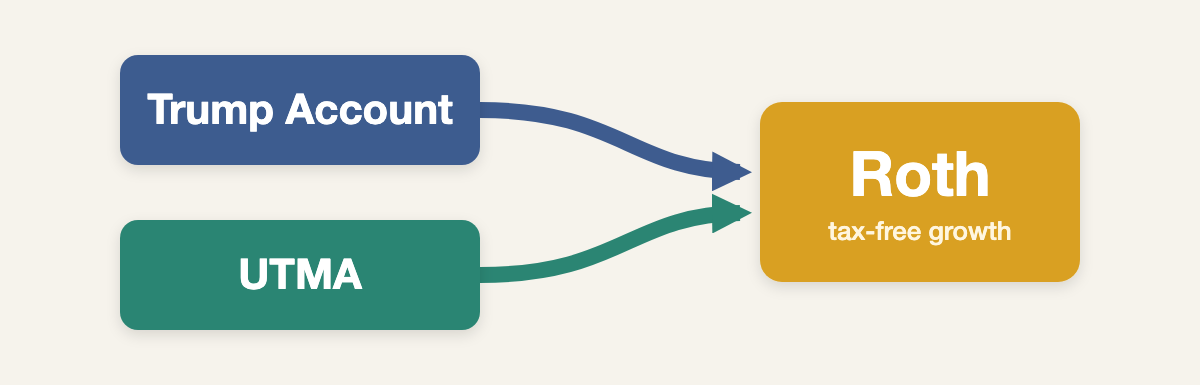
The 2025 Trump tax law created the Trump Account as a new tax-advantaged account type. I wrote about it in Trump Account: IRA for Kids With No Earned Income. It’s basically as the title says, a non-deductible IRA for kids without requiring earned income. It isn’t as good as a 529 plan if you intend to use the money for college education. It isn’t as good as a custodial Roth IRA if the child has income from a job or self-employment. It isn’t as flexible as a UTMA account or a regular brokerage account kept under an adult’s name.
Convert to Roth
Besides collecting the one-time $1,000 from the government for babies born in 2025 through 2028 and the $250 from Michael and Susan Dell for some older kids living in certain zip codes, a good use of a Trump account is to contribute every year until the child is 18, convert it to a Roth IRA in early adulthood, and enjoy 40+ years of tax-free growth.
It’s usually compared with a UTMA account, which can’t be converted to a Roth IRA. However, as we will see in this post, money in a UTMA account can still go into Roth accounts. The older the child is when you start, the sooner that happens.
Ben Henry-Moreland raised a few issues with converting a Trump Account to a Roth IRA in his article on Kitces.com, Why Taxable Custodial Accounts Are Better Than OBBBA “Trump Accounts” For Kids’ Savings. Those include the kiddie tax, the 10% penalty on the conversion tax, and getting bumped into a higher tax bracket when the full balance is converted in one year. Let’s be generous to the Trump account and assume the child converts after graduating college at 22, pays the tax from after-tax salary, and spreads the conversion over a few years.
UTMA
If you contribute the same amount to a UTMA account and invest tax-efficiently, the child will have a similar balance at age 22, especially if you start after the child is already at least 5 years old. The UTMA account just doesn’t earn enough dividends to pay much tax until it grows large.
Ben Henry-Moreland mentioned in passing that money in a taxable account can go into a Roth account:
A taxable account owner could choose to use funds from a taxable account to make Roth contributions, but those contributions would be subject to the annual contribution limit ($7,500 in 2026) …
I will expand on it and point out another path: Roth 401(k). Roth contributions aren’t limited to the $7,500 Roth IRA limit. The contribution limit in a Roth 401(k) is $24,500 in 2026 (soon to be $25,500 in 2027).
Unused Roth Contribution Room
How many 22-year-olds in their first job out of college max out both a Roth 401(k) and a Roth IRA? According to Vanguard’s latest How America Saves report, only 2% of participants under age 25 in its 401(k)-type plans contributed the maximum in 2025.
Most people in their first full-time jobs only contribute enough to earn the employer match. On a typical $60k salary, contributing 6% is $3,600. It leaves $24,500 + $7,500 – $3,600 = $28,400 of Roth contribution space unused.
We’re not even talking about employer plans that allow additional non-Roth after-tax contributions that can be converted to Roth (“mega backdoor Roth“). Or employers that have both a Roth 403(b) plan and a Roth 457 plan. The unused Roth contribution room is larger still if the child lands an employer like that.
Years to Roth Accounts
Assuming that parents contribute the maximum $5,000 every year until the child is 18, and the account earns an inflation-adjusted 7% return, here are the ending balances at age 22 and how fast it can go when the child uses the money to contribute an additional $28k per year to Roth accounts (all in today’s dollars):
| Starting Age | Balance at 22 | Years to Roth Accounts |
|---|---|---|
| 0 | $238k | 12 |
| 2 | $196k | 9 |
| 4 | $158k | 7 |
| 6 | $125k | 6 |
| 8 | $97k | 4 |
| 10 | $72k | 3 |
| 12 | $50k | 2 |
| 14 | $31k | 2 |
| 16 | $15k | 1 |
If you start contributing $5,000 when the child is 8, the UTMA account grows to $97k in today’s dollars when the child is 22. It takes only 4 years to pour the UTMA money into Roth accounts. That isn’t much longer than spreading the Roth conversion of a Trump Account over a few years. Selling from the UTMA account incurs lower taxes because capital gains are taxed at a lower rate.
The older the child is when you start, the smaller the UTMA balance will be, and the sooner it can flow into Roth accounts. The child will pay lower taxes to move UTMA money into Roth accounts than to convert a Trump Account.
If you’re thinking of contributing the maximum to a Trump Account and converting it to Roth, it’s a better move to contribute the same amount to a UTMA, especially when the child is already a few years old. Have the child use it to fill unused Roth contribution room in early adulthood. The tax drag for only a few years is much less than the tax rate difference between capital gains in a UTMA and ordinary income in a Roth conversion. Once the money is in Roth accounts, it’s all the same tax-free growth and worth millions when the child retires.
Learn the Nuts and Bolts
I put everything I use to manage my money in a book. My Financial Toolbox guides you to a clear course of action.
Leave a Reply