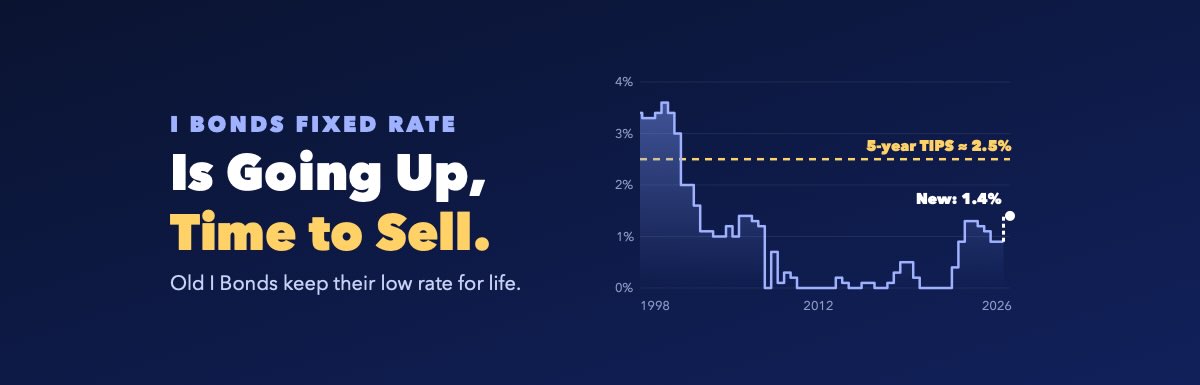
TreasuryDirect sets a new fixed rate for Series I Savings Bonds (“I Bonds”) on May 1 and November 1 each year. The fixed rate effective November 1, 2026, goes up from 0.9% to 1.4%. It’s time to sell I Bonds.
Yes, you read that right. It’s time to sell when the fixed rate goes up.
Reasons to Sell I Bonds
First, the higher fixed rate only applies to new I Bonds bought on or after November 1, 2026. The fixed rate on your existing I Bonds is fixed for life. Your existing I Bonds will continue to earn the low fixed rate set on the original purchase date.
Second, a higher fixed rate for new I Bonds means that TIPS yields are high. Observers have noticed that the I Bonds fixed rate is usually set at 65% of the average 5-year TIPS yield in the previous six months. The current 5-year TIPS yield is about 2.5%. All I Bonds purchased since May 2003 (23 years ago!) have a fixed rate of 1.4% or lower. Both I Bonds and TIPS are adjusted for inflation. Why settle for 1.4% when you can have 2.5%?
Third, you can only hold I Bonds in TreasuryDirect unless you have paper bonds. TreasuryDirect doesn’t have adequate staffing for customer service. Anything not readily handled by the automated system requires waiting months. A reader sent some paper bonds to TreasuryDirect to cash out. It’s been seven months, and it’s still not done. She was told it would take at least ten months. No private financial institution can get away with a timeline like that. If I Bonds are only a small part of your investments, you’ll have one fewer account to manage after you sell I Bonds.
Objections
Let me address some potential objections.
I Bonds are more flexible. You can sell at any time without losing principal!
Exactly, and now it’s time to use their flexibility to earn a higher yield in TIPS. If not now, when? Flexibility you don’t exercise loses its value.
TIPS have interest rate risk. You may lose principal if you sell before maturity.
Only looking at losing principal doesn’t give you the full picture. You lose 3 months’ interest when you sell I Bonds within 5 years. You lose 1% or more each year in foregone interest. These are losses you don’t see.
If you sell a 5-year TIPS after three years, you’ve already earned an extra 3%. After you add the 3-month interest penalty from selling I Bonds, the principal loss must exceed 4% to make you worse off, which is unlikely when you have only two years left until maturity.
Moreover, who says you must have a loss if you sell before maturity? You can also have a gain if interest rates go down. If you don’t think you’ll hold for five years, buy one that matches your expected holding period. You still come out ahead with TIPS that mature in two or three years.
Individual TIPS are confusing. I don’t understand the terminology (auction, secondary market, coupon, index ratio, …).
That’s OK. I wrote a book on TIPS, but I use a TIPS mutual fund in my personal portfolio. It’s just as easy to buy a TIPS mutual fund or ETF as to buy any other bond mutual fund or ETF.
Learn how to build a TIPS ladder if that appeals to you, but a TIPS ladder isn’t the only way to invest in TIPS. If you want payouts on a known schedule, you can also buy a set of Term TIPS ETFs. A 2028 TIPS ETF holds TIPS that mature in 2028. It will liquidate and pay out in 2028. A 2031 TIPS ETF holds TIPS that mature in 2031. It will liquidate and pay out in 2031. And so on.
I Bonds are tax-deferred. TIPS are taxable every year.
TIPS are taxable every year only if you hold them in a taxable account. You can buy TIPS in an IRA. Tax-deferred only delays taxes. You’ll pay taxes on I Bonds interest eventually anyway. At current rates, the reduction in interest income (1% or more) represents 20% of deferred interest (about 5%). Tax deferral has some value, but it’s not worth 20%.
I’ll have to pay taxes on all the accrued interest if I sell I Bonds.
See? Tax deferral has become a trap. The longer you hold I Bonds, the deeper you’re trapped. Now you have to figure out how to come out of the trap. You won’t have this problem with TIPS. See “How Much Room for Taxes” below for how to unwind.
I’ll lose three months’ worth of interest if I sell I Bonds within five years.
The size of the interest penalty depends on inflation and the fixed rate on your I Bonds (see the section below for a lookup tool). At the current inflation rate, you make up for the interest penalty in one year or less.
Suppose you bought I Bonds in November 2023 when the fixed rate was 1.3%. The current inflation adjustment is about 3.5% annualized. The 3-month interest penalty is (1.3% + 3.5%) / 12 x 3 = 1.2%. Switching from I Bonds with a 1.3% fixed rate to TIPS that pay 2.5% will make up for the interest penalty in one year. 2.5% – 1.3% = 1.2%. The breakeven will be shorter if your fixed rate is lower.
If your I Bonds are less than one year from their 5-year mark, wait until they cross that line. Otherwise, you’re better off switching.
Look Up Fixed Rate
If you agree it’s time to sell, review your current holdings first. Log in to your TreasuryDirect account. Click on Current Holdings in the top menu. Select “Series I Savings Bonds.”

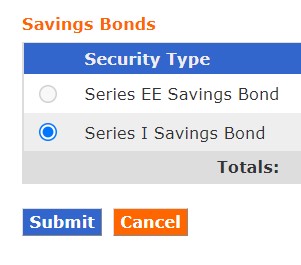
Note the Issue Date of each bond. Bonds issued within the last 12 months can’t be sold yet. Of the rest, those with the lowest fixed rate are your first candidates to sell. However, TreasuryDirect doesn’t display the fixed rate for your holdings. You can use the lookup tool below to see the fixed rate based on the Issue Date.
How Much Room for Taxes
The difference between Amount and Current Value is the accrued interest.
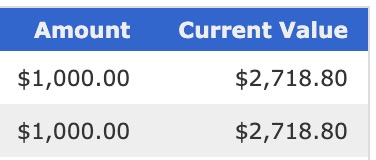
Selling these two bonds will trigger $1,718.80 in interest income for each bond, or $3,437.60 for both. The interest will be taxed for federal income tax but exempt from state income tax.
If you worry that the interest income may push you into a higher tax bracket, you can use my tax calculator to see your current marginal tax rate and how much room you have in that same rate. You can sell some in 2026 and some in 2027 if you have limited room for taxes. TreasuryDirect allows selling a partial amount from a holding.
Logistics
You’ll need an ID.me account to access TreasuryDirect after October 28, 2026. Make sure the linked bank account is still active (ManageDirect -> “Update my Bank Information”). You don’t want the money to go to the wrong place.
The best time to sell (“redeem”) is at the beginning of a month, right after the 1st, when TreasuryDirect credits interest for the previous month. You can’t schedule your redemption in advance.
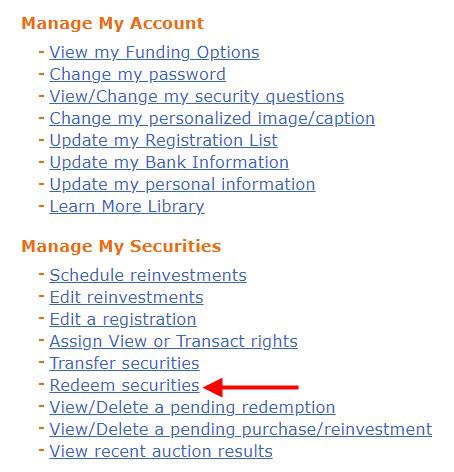
You can sell/redeem one bond at a time from Current Holdings, or you can sell/redeem multiple bonds from ManageDirect -> “Redeem securities.”
TreasuryDirect won’t withhold any tax by default. You can set up voluntary tax withholding if you prefer to have them withhold a percentage. See Voluntary Tax Withholding on Selling I Bonds at TreasuryDirect. Either way, remember to log in again next January to get your 1099 form.
Learn the Nuts and Bolts
I put everything I use to manage my money in a book. My Financial Toolbox guides you to a clear course of action.
Steve says
A lot of complexity with I-bonds. Are I-bonds worth it? I’ve seen lots of posts online from people who have problems dealing with Treasury Direct.
There is lots of value in simplicity. I-bonds and/or Treasury Direct are not simplicity.
To those of you who need this article’s information, good luck.
Susan says
Thanks for the timely information! One question: My husband just retired, so it would be better for us (tax-wise) to sell our iBonds next year in 2027. Does it make a difference if we sell in January, instead of before the November rate re-set? Thank you for your thoughts.
Harry Sit says
Setting a new fixed rate on November 1 only affects new bonds. It doesn’t affect existing bonds. Each existing bond has its own variable interest rate cycles based on the issue date. The cycle doesn’t necessarily reset on November 1.
Josh says
Tips are for retirement accounts. I-bonds are for taxable accounts. Meaning that if you dont have room in retirement accounts you should buy I-bonds.
Harry Sit says
Nothing stops one from buying TIPS in a taxable account. Many people buy CDs from banks. Those are in regular taxable accounts.
Sylvi says
RE: this statement is incorrect: “You’ll need an ID.me account to access TreasuryDirect after October 28, 2026.”
The correction should read:
You need an id.me account to access Treasury Direct beginning ON Oct 28, 2026.
Sylvi says
oh, delete this comment. The way Treasury Direct has stated the date in some places has created confusion, but it may be correct that you don’t need id.me until after October 28, 2026 (but it may depend on your time zone).
oonert says
I-bonds proceeds are tax free for qualified taxpayers using them for education expenses.
Harry Sit says
Put the money in a 529 plan. Better returns and fewer strings.
Big-Pops61 says
Ibonds and TIPS work in different ways. When you then add the different reasons for when one might choose one and when might choose another, there’s no simple answer that applies to everybody.
For example – we have plenty of TIPS in our IRAs in the form of ladders. They’re a major part of our spend for daily life – we’re retired so no real way to continue to contribute there, even if we wanted to.
We own plenty of I-bonds as well. One of the reasons is their tax-deferred nature. This allows us to continue to maximize our Roth conversions annually. We have no intention at all of getting rid of any of our I-bonds before maturity, other than possibly to upgrade some of the lower yielding ones at some point.
Finally, I’m truly sorry for those who have had difficulties with TD. We’ve dealt with TD for over a decade both with I-bonds and rolling T-Bills (in the past) and have experienced nothing like that. I’m also starting to see more examples on some online forums where things have actually gone smoothly, even for inherited I-bonds, though I suspect that fewer people post about things going as they should than when they don’t. And we’ll never know the nitty gritty details of what might have happened when things didn’t go as expected.
Harry Sit says
Let’s put down some concrete numbers. Suppose you have $200,000 in low fixed rate I Bonds. At current rates, you defer $200,000 * 5% = $10,000 of interest income. This allows you to increase your Roth conversion by $10,000. But you also earn at least 1% less from those I Bonds. That’s $200,000 * 1% = $2,000 (more than $2,000 if your I Bonds have fixed rates lower than 1.4%). The $2,000 foregone income is 20% of the $10,000 increased Roth conversion. The $10,000 Roth conversion must save more than 20% to be beneficial.
In addition, the $10,000 tax deferral only defers it to the future. It comes back when you sell or when the bonds mature. The accrued interest will reduce your Roth conversion that year.
Big-Pops61 says
Your numbers have no resemblance on what I’m actually doing and you’re making some assumptions that don’t actually apply to my situation. I’m not asking for advice, either.
My point stands – there is no single answer that applies to everybody.
Cheers
Harry Sit says
Of course not. Putting down some numbers lets us see the actual effects more clearly, as opposed to only conceptually. Something is good. How good is it? What are the trade-offs? I agree there is no single answer. I’m only saying the answer should come from considering all factors. The numbers are only an example. Replace those numbers with one’s actual situation. The answer then comes more easily.
Big-Pops61 says
Then it looks like we’re in agreement.
Nobody should have a Roth conversion plan without having already modeled what they’re trying to do, and that includes the effect of options being considered.
Cheers.
PJ Martin says
I am with you on the I-Bond tax deferral to maximize annual Roth conversions and previously for income minimization while utilizing the ACA. Will happily forgo the lost interest now to avoid higher tax brackets when RMD’s begin.
Marc says
Reason #1 assumes a few things:
1) You don’t have I Bonds with a fixed rate comparable to the expected 1.30%-1.40% fixed rate after 11/1/26.
2) You didn’t sell any 0% or otherwise low fixed rate I bonds held less than 5 years three months after the 11/1/24 rate change of 1.8% when the tax penalty was the lowest in recent years and can deploy that cash now to either the upcoming I Bond or TIPS.
3) You wouldn’t take an enormous tax hit by selling all your I Bonds all at once.
Reason #2 assumes an either/or choice of owning I Bonds or owning TIPS when the two investments, despite both providing inflation protection, can serve two distinct purposes in two different types of accounts.
Reason #3 is a negative in practice fir some, but only a negative in tgeiryy fir others..
Regarding your objections, flexibility doesn’t always mean switching investments, it can also refer to being able to liquidate quickly when the funds are needed without losing principal, which you can always do with I Bonds.
And in your response about TIPS being taxable every year, you mentioned not if they are held in an IRA, which is true. But what you didn’t mention is that you lose the state-tax free benefit that I Bonds have when you own TIPS in an IRA. For those living in high tax states, that can be a significant issue.
Lastly, you mentioned the need for an ID.me account which is mandatory and exclusive as of 10/29/26. What you didn’t mention and I think deserves attention is how problematic that is for some people, so much so that it could provide the impetus for selling I Bonds now and buying TIPS instead. ID.me has documented security lapses and dishonest transparency issues and its own customer service problems. Moreover, it cannot verify the identity of ex-pats living overseas. People in that situation have been consistently commenting on that flaw on the Chang.org petition to modify the ID.me migration, which btw now has over 422 signatures and a number of interesting comments:
https://www.change.org/p/modify-the-mandatorytreasurydirect-id-me-migration-protect-investor-privacy-and-access
Harry Sit says
You’re ahead of the game if you already sold low fixed rate I Bonds after 11/2024. The 1.3% – 1.4% fixed rate I Bonds are still good candidates to sell, for the reasons mentioned in this post. I’m working on selling I Bonds with a 1.6% fixed rate. The tax issue is addressed in the “How Much Room for Taxes” section. I’m not suggesting selling everything at once. Sell only as much as you have room for taxes.
For any amount kept in low fixed rate I Bonds, and I treat low fixed rate as 1.4% or lower, I’m highlighting that there’s a cost. Behavioral biases make us blind to the foregone income and overly sensitive to the possible principal loss. This post attempts to bring that cost front and center. Not losing principal is nice, but there’s an ongoing cost. If we keep low fixed rate I Bonds as an emergency fund for another 10 years, we fall 10% behind. How is that better than possibly losing principal from selling TIPS? The foregone income must be part of the consideration.
Marc says
You make valid points (as always) in arguing for TIPS over I Bonds, but I’m still going to disagree on a few points from your response:
1 – Maybe it’s subjective, but a 1.40% I Bond Fixed Rate should not be considered low. It is, in fact, tied for the highest I Bond fixed rate in a quarter century. Since we can’t use a Time Machine to go back to the early 2000s, it’s a rate worthy of consideration even at 1% less than a TIPS, for other reasons that add up (see #3 below).
2 – You published this article the day 5-year real yields crashed .20% from 2.55% to 2.35%, ending the week at 2.34%. That points out another benefit of I Bonds over TIPS, 6 months of backward looking yields which you can lock in in the present for the future (an actual Time Machine effect).
3 – Your main point is that none of the features unique to the I Bond make up for the 1% difference in yield, but taken together they could tip the scales (pun intended) — no phantom income, compounding interest, tax deferral, full control over the timing of incurring income tax, the tax impact of cashing out (bracket creep, IRMAA, ACA subsidies, senior deduction), put option flexibility to cash out when you need it, the principal not fluctuating with market conditions, the deflation protection, and the higher education federal tax exclusion option.
My conclusion — I Bonds with fixed rates at the upcoming level work well beating inflation in a taxable account as a cash fund superior to Money Markets, CDs, and Treasuries. TIPS at these real yields with 5, 10, 30 year terms are better suited for an IRA.
Harry Sit says
As Big-Pops61 pointed out in earlier comments, there is no single answer that applies to everybody. As long as we’re aware of the full trade-offs, each person can reach a different conclusion. The benefits of I Bonds are obvious, as you mentioned: stable value, tax deferral, a small time machine, etc. The opportunity costs aren’t as obvious. Some people may only look at the 1.4% yield as the highest in 20+ years, not realizing that the cost is also the highest in 20+ years.
I was one of them. Take the 1.6% fixed rate I Bonds I’m trying to unwind now as an example. TIPS yield was abut 2.7% at that time. The gap was about the same as it is now. I bought those in early 2003. The fixed rate dropped soon after I bought them. I was happy that I got in before the drop. I’ve held those I Bonds until now because I couldn’t get back to the same rate if I sold. The flexibility became a lock-in. Taxes have become a problem at the back end (bracket creep, IRMAA, ACA subsidies, senior deduction). That’s why I’m selling them.
Marc says
“I was happy that I got in before the drop. I’ve held those I Bonds until now because I couldn’t get back to the same rate if I sold. The flexibility became a lock-in.”
So to summarize, you were happy when you bought this investment, you held it for 23 years, you had the flexibility along the way to cash out if you needed to or use it for education expenses federally tax free, you had deflation protection the whole time, you deferred federal taxes the whole time, you earned a real yield of 1.6% above inflation with compounding the whole time, the rate you got has never been exceeded in all that time, so you made the choice to lock it in, and now you get to choose that the timing is right for you to redeem them and incur the taxes now, which is also one of the I Bond benefits, and all this is a problem? 😂 As someone who wasn’t aware of I Bonds back in 2003, I wish I had that problem, and I wouldn’t have any regrets even understanding the cost.
Thank you for pointing out the cost benefit of TIPS today. I do understand your point and it’s an important perspective to consider.
Harry Sit says
To be clear, I was happy only because I didn’t know or look at the alternative. I had tunnel vision only in the world of I Bonds. My flexibility became false flexibility quickly. I could sell in theory, but I would give up all future income from a good rate. Losing future income isn’t any better than losing principal. Buying 1.6% fixed rate I Bonds looked like a win, but it wasn’t. If I could tell my younger self 23 years ago, I would say to buy TIPS at 2.7%.
Evan says
Harry, you may be confusing strategy for outcome. Yes, a TIPS purchased in 2003 and held for 23 years would have been great investment. But it would have been a bumpy ride along the way, much more so than the ibond. That you did not need to redeem the ibond is not to say that you might not have needed to.
As an alternative, the stability of the ibond could have allowed you to take more risk on the stock side, which would have compensated you vastly more than the 1% (pre-tax) difference between the 2003 TIPS and ibond. You should calculate the risk adjusted returns or sharpe ratios of stock-TIPS and stock-ibonds portfolio.
Also a fair bit of hindsight bias here. Obviously, we know the first order inflation-adjusted results of TIPS vs ibonds purchased at the same time and held to maturity, although the tax drag of TIPS increases with more inflation in a way that it doesn’t for ibonds. But you might as well say, “Look you could have bought AAPL” or whatever. Yes, of course there is something better you could have bought, but the risk characteristics are completely different.
Arthur McBride says
Only bad part about having any kind of treasuries in pre tax retirement accounts is you lose the not paying state taxes benefit when taking distributions.
Mel says
Thank you for this timely article. Would VIPIX be worth it, if I sell my November 2023 $2,000 Ibonds in my taxable TreasuryDirect account and buy $2,000 in VIPIX instead (within my 403b)? That’s the Inflation Bond Fund I’m offered at TIAA. (I’d realize about $250 in taxable income if I sell the Ibonds.) Thank you. -Mel in Florida
Harry Sit says
VIPIX is Vanguard Inflation-Protected Securities Fund Institutional Shares. It invests in practically all TIPS available, maturing from 2027 to 2055. Most of my fixed income allocation is invested in a fund similar to VIPIX.
$2,000 is a small amount. It doesn’t matter much either way.
Patrick says
I regularly read TFB as it is a no nonsense webssite providing real life tips which we can actually use. However, I am disappointed with this click bait article. TFB is known for its thoroughness but this article is short sighted without considering the tax deferral benefits of Ibonds. In fact TFB himself has written an article regarding staying on the left of the cliff for ACA. This will be a disaster if anyone tries to follow this advice before 65. Hope TFP provides a comprehensive analysis of Ibonds Vs TBills without narrowly looking at the 2% incremental interest. What do we lose by narrowly focussing on just incremental interest.
Harry Sit says
The “how much room for taxes” section addresses tax issues. Not suggesting everyone selling everything at once. Some people have more room. Some people have less room. I provided a tool to calculate the room, for both people under 65 and over 65. I use the same tool to calculate how much I can sell this year and next year.
This post accidentally created a great example for loss aversion in prospect theory. The gain is valued half as much as the possible loss.
Marc says
I’m probably missing something and you’re the right person to figure out what it is.
Are you familiar with this website:
https://eworkpaper.com/robn
It claims to “Evaluate if replacing old I bond with a new I bond is more beneficial than holding the old I bond.”
I own a $10,000 I Bond with a 0.4% Fixed Rate bought April 2023. Your article makes it clear to sell the I Bond and buy TIPS instead of the new I Bond, I get that. But I wanted to look at if I should sell the I Bond and buy the new I Bond instead.
When I inout the data in the 24% tax bracket, it tells me it will take 52 months to break even. Why is that? I assume it is taking the 3 month penalty and the tax hit into account, as well as starting over with the original principal instead of compounding the new higher principal.. If that’s accurate, it doesn’t make sense to swap the I Bond out and wait 4 1/3 years to break even. It leads me to conclude that I shoudl keep that I Bond until I need the cash and if I want the new I Bond, use new money to buy it.
Is that right from your perspective?
Harry Sit says
I’m not familiar with that website, but I tried it anyway. It’s not correct. If you have a way to get in touch with the developer, please mention these flaws:
(1) When you use $10,000 as the amount of the old I Bonds, the interest earned thus far is disregarded in the breakeven comparison. In your case, the old I Bonds are worth $11,051.84 after paying taxes. It assumes that you use $10,000 to buy new I Bonds and keep $1,051.84 in a 0% checking account. Only $10,000 earns extra interest to recover the early withdrawal penalty and the tax paid. For a better comparison, start with $1,000 in old I Bonds, and use 100% of the proceeds to buy new I Bonds.
(2) It counts tax on selling old I Bonds to buy new ones but not on holding old I Bonds. In other words, it uses the post-tax value after selling to match the pre-tax value if you held them. This exaggerates the breakeven period. For a better comparison, use a 0% tax rate in that calculator. You will pay tax on the interest earned so far eventually. Selling only makes you pay it sooner. It’s not an extra tax.
Combining (1) and (2) shows you break even in 11 months.
Marc says
Thank you. It didn’t pass the reasonableness test that the breakeven would be as long as the site calculated.
The concept of the site is helpful, it’s the calculations that go off the rails. It reminds me of the Seinfeld episode about the restaurant being good at taking the reservations but not holding the reservations, which is the most important part. The calculations are the most important part.
Is there another online tool that you know of that correctly does what this site purports to do?
Harry Sit says
I don’t know of another online tool, but AI is perfect for this type of math problem. Claude says you’ll break even in 15 months, which makes sense to me. The new I Bonds will have another early withdrawal penalty. They have to wait a little longer to get 3 months of interest credited.
https://claude.ai/share/705cc9e1-1e8c-4a57-9429-bdaa214ccc98
Big-Pops61 says
#cruncher over on bogleheads created a tool a while back. He’s the owner of the website, eyebonds.info
The post with a link to the googlesheet spreadsheet (make a copy first)
https://www.bogleheads.org/forum/viewtopic.php?p=8888753#p8888753
Cheers
Marc says
Thank you for the Claude link. AI can certainly do the math, but an accurate online tool (perhaps driven by AI) would be easier for people to make these determinations. The most sensible future for anyone holding this bond is redemption no matter how you look at it, so it’s a matter of when, not if.
Option 1: Redeeming now is a no-brainer from a long-term perspective.
Option 2: A 15-month break even (which is what I wanted to know so thank you again) on a bond that reaches the penalty-free five year mark in 17 months is roughly a wash from a short-term perspective if cashing out in 2028 is a consideration from a cash flow perspective.
Option 3: Another decision-point is January 2027 which will be three months into the current interest rate applied to the bond before it increases three months after that. The 3-month penalty in January will only be a few dollars more than it would be now but it gets you into a new tax year, deferring the tax on the interest for another 14 months before it has to be paid. The $10,000 principal could then be used to buy the 2027 allocation of I Bonds in April or May (or even October or November) depending on what happens with inflarion and the fixed rate at those times. I may consider this option.
I don’t want to belabor a very specific example any longer, but the exercise was helpful in thinking through the options and understanding the math. One of the benefits of the I Bond that we’ve discussed is the liquidity flexibility. That is pretty evident in this example.