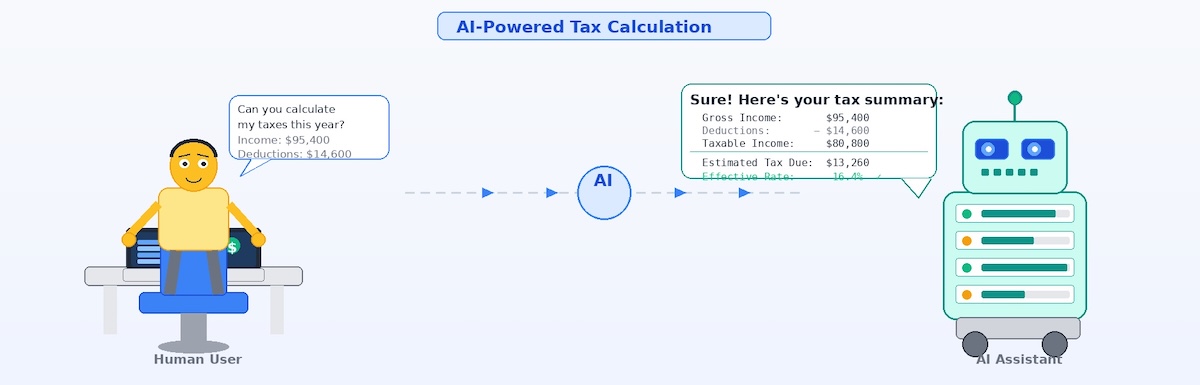
Several readers asked me whether they could use AI to calculate taxes after reading my stories about AI helping me with home electrical and water heater problems in the previous post AI Gives Better Answers Than Google. They want a tax projection to help with setting tax withholding, paying estimated taxes, or planning for Roth conversions.
My immediate reaction was that calculating taxes isn’t the best use of AI, because it falls under “verifiable facts” and “latest development” categories. The retirement plan contribution limits, tax brackets, the maximum deduction amounts, etc., are all verifiable facts. The IRS sets them every year, and they are what they are. Just go to the IRS website for the latest numbers, or Google. If you ask AI, it had better get the latest numbers online anyway, because AI’s training lags.
On the other hand, tax rules are complicated. After you have all the latest numbers from the IRS, you still need to apply the complex rules — what counts and what doesn’t, and which rates apply to which income. Online tax calculators usually don’t cover the current year until late in the year, and they can be either too simple or too complicated. It would be nice to have AI calculate taxes specifically for the types of income and deductions we have: not too simple with only limited inputs, and not too complicated with everything under the sun.
The Quiz
I thought I would test how well AI calculates taxes. I came up with this quiz question:
Jill, single, age 63, has these incomes in 2026:
- $30,000 from Social Security
- $10,000 from interest and pre-tax IRA withdrawals
- $37,000 from qualified dividends and long-term capital gains
- $1,000 from muni bond interest
Jill contributes $4,400 to her HSA and donates $1,500 in cash directly to charities. What’s Jill’s federal income tax for the 2026 tax year?
I designed this question carefully to cover several calculations. Slightly less than 85% of Social Security is taxable in this case. AI has to know how to calculate the exact taxable amount, and not just make a straight 85% of Social Security taxable. The gross income consists of ordinary income, tax-exempt income, and investment income taxed at preferential rates. The ordinary income component goes across two tax brackets. So does the investment income. One deduction is above-the-line, and the other is below-the-line.
I added these instructions to encourage AI to get the latest tax numbers from the IRS:
It’s important to calculate it accurately. Please use tax amounts only for 2026 and only from official IRS sources.
Initial Results
First, I ran the test case through my tax calculator in Calculator: How Much of My Social Security Benefits Is Taxable?. It gave this result:
$25,410 of your Social Security benefits is taxable, which means 15% of your benefits is tax-free.
Your 2026 federal income tax is approximately $1,640.
This is calculated from a taxable income of $50,910 (AGI $68,010 – Standard Deduction $16,100 – Senior Deduction $0 – charitable contribution deduction $1,000).
Then I sent the quiz to all four major AI chatbots: ChatGPT, Claude, Gemini, and Grok. I only used the free version in each one, with the free Thinking, Pro, or Expert mode enabled. I compared the answers to the correct result from my tax calculator.
| Source | Answer |
|---|---|
| My tax calculator | $1,640 |
| ChatGPT 5.4 Thinking Mini | $325 |
| Claude Sonnet 4.6 Extended | $1,910 |
| Gemini 3 Pro | $1,910 |
| Grok 4.20 Expert | $1,910 |
My quiz was too hard! All four major AI models failed to give the correct answer. The $1,500 cash donation threw them off. It falls squarely in the “latest development” category. The charity donation deduction for non-itemizers is new. The AI models all have “donations are deductible only when you itemize” imprinted in their training. Claude, Gemini, and Grok all would have given the correct answer if I hadn’t included the cash donation. ChatGPT was off on how much of Social Security is taxable.
When you see AI not giving you a deduction, you can raise a question and ask it to double-check. I followed up with this statement:
I heard that cash donations are deductible for people using the standard deduction, starting in 2026, up to a limit.
I only said “I heard,” which may or may not be true. AI still has to verify. I also added this request for ChatGPT:
Another AI model calculated a different amount for how much Social Security is taxable. Please double-check your calculation to see who’s right.
Round 2
All four AI chatbots double-checked and revised their answers.
| Source | Answer |
|---|---|
| My tax calculator | $1,640 |
| ChatGPT 5.4 Thinking Mini | $1,640 ✅ |
| Claude Sonnet 4.6 Extended | $1,640 ✅ |
| Gemini 3 Pro | $1,411 |
| Grok 4.20 Expert | $1,411 |
ChatGPT and Claude got the correct answer. Gemini and Grok mistakenly treated the cash donation deduction as above-the-line and used it to reduce the Social Security taxable amount.
I asked Gemini and Grok to clarify whether the HSA contribution and the charity donation should or shouldn’t be included in calculating the Social Security taxable amount. Gemini didn’t realize its mistake. It said both should be included. Grok refused to go further because I reached the message limit for not having an account. [A reader with a Grok account did the same chat with Grok and told me that Grok also said both should be included.]
Here are the full chat transcripts. They make an interesting read.
https://chatgpt.com/share/69bf73fb-db44-8004-9905-b77b56fbb6ce
https://claude.ai/share/ef62408a-6502-4d70-82be-6ea46a4a4cc3
https://gemini.google.com/share/795bdad9f5ad
[No sharable link for Grok because I don’t have an account.]
Impressions
I don’t think we can draw definitive conclusions based on only one test. I call these impressions.
1. Whether AI can calculate taxes correctly depends on the complexity. Three out of the four major AI chatbots would’ve given the correct answer in one go if the question didn’t include the new and tricky charity donation deduction. The explicit request to retrieve the latest information from official IRS sources and turning on the Thinking/Pro/Expert mode probably helped in improving accuracy.
2. AI works better when you make it a conversation. Don’t stop and say it’s useless when you spot some errors in the initial answer. Help the tool help you. Both ChatGPT and Claude reached the correct answer in Round 2 after I asked them to double-check.
3. It takes little effort to send the same question to two or more AI models. You don’t need to know which AI is correct when you get different answers. You can tell one AI that another AI said something different. It’ll re-examine.
4. AI was wrong because human sources were wrong. Gemini and Grok treated the donation deduction as above-the-line because many human sources incorrectly called it above-the-line. If you Googled, you would encounter those incorrect sources too. ChatGPT and Claude used more reliable sources and correctly identified the difference between above-the-line and not requiring itemizing deductions.
5. An online tax calculator is faster and more accurate if you know which one to use. That’s a big “if.” Only saying “Don’t use AI because it’s often wrong” doesn’t say where you will find more reliable sources.
As much as I’d like to see everyone use my tax calculator, let’s face it: 99.99% of people don’t know that I exist. They have little chance of finding the few sources that do it accurately because Google doesn’t rank tax calculators by timeliness or thoroughness.
Here’s a small challenge for you:
Pretend you’re not familiar with tax calculations. Find another way to answer the quiz question. Don’t say “I have a spreadsheet,” or “I use the super-duper Case Study Spreadsheet or Excel1040.” 99.99% of people don’t have those. Please tell me in the comments section how you could do it otherwise.
Short of finding the good sources, the results from AI aren’t that bad (see #1).
6. AI’s general approach was correct even when it was wrong in some nuances. All four AI chatbots followed these correct steps:
- Calculate how much of Social Security is taxable
- Calculate AGI
- Calculate taxable income
- Separate ordinary income and preferential investment income, and know how they stack
- Apply different tax brackets
This general approach is “common knowledge of an insider.” You can learn the steps from AI if you’re not familiar with tax calculations. That’s more valuable than just having a final number. When I saw that ChatGPT didn’t include details of some interim steps, I asked it to show its work. ChatGPT explained the details faster and better than I could (read the transcript).
An online tax calculator gives you a number but doesn’t explain the steps. AI is a better tool in teaching you how to fish than giving you a fish.
Learn the Nuts and Bolts
I put everything I use to manage my money in a book. My Financial Toolbox guides you to a clear course of action.
Dan says
A chatbot is not tax software. The way you ask the question matters immensely.
The way you asked the question – expecting multiple, complicated, and overlapping calculations in one go is the worst way to get good answers.
I bet all the answers would be correct, have you broken these questions down into individual components and asked them separately within the same chat.
This “quiz” illustrates well why people unfamiliar with either how LLMs work AND with the domain they ask about get mediocre answers.
Harry Sit says
AI did quite well with my “worst” way of asking. The neither above-the-line nor itemized donation deduction is too new. 2 AIs even got that one right. That’s impressive. I don’t hold it against the other 2 that didn’t get the subtlety.
REA says
Perhaps the technology needs more maturity — an AI tool should not expect the user to know how LLMs (Large Language Models) work. Maybe technology will get to the point where if the AI tool perceives that the scenario (input) is too complicated, the AI tool will come back to the user and ask for clarification. Maybe the AI tool should respond back to the user, breaking down the facts one-by-one, and be responsible to clarify what the user is asking.
>> I bet all the answers would be correct, have you broken these questions down into individual components and asked them separately within the same chat. This “quiz” illustrates well why people unfamiliar with either how LLMs work AND with the domain they ask about get mediocre answers.
jcb says
Yup, you can’t ask probabilistic models (AI) to do deterministic calculations. You can use them to control deterministic calculations. It’s like asking an untrained human to do their own taxes without calculators, spreadsheets, or even the tax worksheets.
Steve says
JCB: grok agrees with you. Here its summary reply about your comment:
“Bottom line for anyone actually doing taxes
-Never treat an AI chat’s final number as gospel if you’re filing.
-Do use the AI to design, check, or automate the deterministic part (code, spreadsheet, etc.).
-Then verify the output with official software, a CPA, or at least a second deterministic run.
So yes—the statements nail the real limitation and the smart way around it. AI chats are fantastic tax assistants, but terrible tax calculators on their own.”
Link to grok conversation about jcb comment: https://x.com/i/grok/share/c78fdb439c8d49e29dc7ce2bd63b6f78
KWP says
I just use FreeTaxUSA, including to go through multiple scenarios before Roth IRA conversions. Super easy, and if you can’t live without the details of a calculation, it’s there (or at least, the IRS form is). If you want to start an entirely different iteration, create a new user identity. I don’t feel like I personally need to reinvent the wheel.
Harry Sit says
FreeTaxUSA does 2025 now. It won’t do 2026 until maybe November.
REA says
I admit I would have to use some sort of spreadsheet and referencing multiple sources to come up with calculations.
Timing is a problem because I don’t think most tax prep programs have updated logic (early in the year) to give you a good estimate for end-of-tax-year scenario.
I find it’s very difficult to find accurate and not-outdated information from web sources.
MDM says
At least four of the Tax Estimation Tools covered in that Bogleheads wiki page (see https://www.bogleheads.org/wiki/Tax_estimation_tools#Latest_tax_year_available) have 2026 tax numbers now.
Harry Sit says
I mentioned two of them. “How do people find one of those four tools?” is still the question. The Bogleheads Wiki page or any of the four tools doesn’t show up in the first 5 pages of Google when I searched for “tax estimation tools.” It’s difficult to find any of them unless you already know them by name.
MDM says
Harry, good point.
When I search for “tax estimation tools” without the quotes, I get results like you describe.
When I keep the quotes, the BH wiki page is the third result on the first page. Don’t know if that would be the case for everyone, nor what fraction of people would choose to put that search phrase in quotes.
As there is little (or no) financial incentive for developers of the free tools to advertise, engage in search engine optimization, etc., forums like yours, Bogleheads, MMM, etc., and threads like this are probably the main drivers of awareness for those tools.
Steve says
I used several chat AIs to estimate 2025 taxes before receiving 1099s. I liked the way the responses outlined the income, deductions, and tax calculations in a step-by-step basis.
In several cases I had to prompt the AI to recalculate results for new tax provisions in 2025.
I found AI particularly useful in generating the state tax owed for a state that I do not live in and have less familiarity with its taxes.
Giving the same tax info to several AI chats and comparing differing results is a good way to spot problems and learn the details of tax calculations.
It is important to prompt AI with key details about the tax situation. But, to know which details are “key”, you need to be very familiar with how taxes are prepared.
I will use AI in the future for during the year tax planning and estimation.
Michelle says
I’ve been playing with Gemini to help me determine my 2026 quarterly tax payments since 2026 will be a very different income year compared to past years. So far, it’s been kind of fun, but I’m going to use your calculator as well. I feel about AI as I have felt about a calculator – you kind of have to have an idea of the answer to know if it’s correct or not.
Gotadimple says
I use the 1040 Tax Calculator from dinkytown.net. You are asking ‘how do you forecast what your 2026 tax bill will be?’ So today, I get the results in 2025 terms – then I forecast from there – specifically because my dividend income is the not the same from year to year.
Doug Wittig says
I have been enjoying your recent articles about AI. I find them to be very pragmatic and agree with the impressions that you list
Rom says
Great experiment – I’ve been using LLM’s heavily (paid versions of ChatGPT and Gemini with custom projects/gems specific to retirement planning, tax, real estate and finance).
I also have my own spreadsheets I use to estimate taxes and mainly use LLM’s to check that I’m doing something right or wrong and ask very specific questions with very specific scenarios to check. They DO make mistakes on a regular basis but as you say, a conversation is the way to go and in many cases MY understanding increases by circling around the error that was made – have had multiple “aha” moments as a result of follow ups about an error. (The real problem is when people either take their responses as truth or just dismiss it when there’s an error – they are missing out on serious help.)
Biggest one for me happened when I filed my taxes with paid tax software this year. The software told me that I should be itemizing and I was shocked – haven’t itemized since SALT was capped. Went to ChatGPT and it told me the software was wrong in its calculation (basically JUST my NY income tax put me above what the standard deduction would be). I was really surprised and had to poke around and realized the OBBB had lifted the SALT cap – it was a real challenge to get ChatGPT to accept it (it kept pointing to sourced from fall 2025 before it passed).
Over the last 2 years my main task at work has been to strategically rollout LLM’s in an enterprise environment and more than any software I’ve evaluated with users (I’m a UX research/strategist), LLM’s depend on the user’s mindset to be a success or failure.
Peter Kendall says
“Gemini and Grok mistakenly treated the cash donation deduction as above-the-line and used it to reduce the Social Security taxable amount.” Isn’t the new charitable deduction for non-itemizers above the line? Or did you mean that for purposes of Social Security tax calcs, you have to “add back” the charitable amount to AGI?
Harry Sit says
It’s not above the line. It doesn’t lower the AGI to begin with, and therefore it doesn’t get added back. Details are in the linked post and in the explanation by ChatGPT and Claude.
Steve says
The new charitable deduction effective in 2026 tax year was included by the OBBBA as a modified provision of IRC Section 170.
Section 170, and its parent Subchapter B Part VI “Itemized Deductions for Corporations and Individuals”, are specifically deductions allowed for computing taxable income.
The deduction is not included/excluded in Section 62 “Adjusted Gross Income – Defined”.
The charitable deduction does not affect the calculation of AGI. “Above the line” means affecting the calculation of AGI.
What is interesting is how many tax authorities/CPAs/tax professional organizations have described the charitable deduction as “above the line”. “Above the line” does not mean a deduction that a taxpayer does not need to itemize.
It’s not any wonder that AI chats are confused. I kept re-prompting Grok to provide the legal authority for its conclusion that the deduction was above the line. It cited the statutes, but would not dismiss the tax professionals. It finally reported that it was best to wait for IRS to clarify the matter and release the 2026 filing instructions.
This led me to actually read the IRC just to confirm whether Harry was right or not.
R T says
The all-four-failed round one is the result everybody building with these tools should tape to the monitor. We run a job board for traveling skilled trades workers and we use AI in our tools, and the rule we landed on early is the same one your test points to: the model never gets to be the source of a number. Our people live on per diem, and the GSA tables change every year – exactly the kind of figure a model will state confidently and get wrong, same as your charitable deduction example. So the model reads and summarizes, and dollar figures get checked against the government table before they show. Your round two is the tell: the models can verify when pushed, they just do not push themselves. We keep AI answers tied to the government tables because in tax and pay, close enough is wrong.