Backdoor Roth: A Complete How-To
Although I believe a traditional deductible IRA is often better than a Roth IRA, a Roth IRA is still better than a taxable account if you aren’t eligible for a traditional deductible IRA. When you aren’t allowed to contribute to a Roth IRA because your income is too high, there’s still a backdoor.
It takes some effort but it’s worth it. I did the prep work last year and I was able to use the Backdoor Roth. Although I wrote about it in Rollover IRA to Solo 401k last year, I see many still don’t know how to work the backdoor.
So here it goes: a complete how-to for the Backdoor Roth.
What is the Backdoor Roth?
The Backdoor Roth is an indirect way to contribute to a Roth IRA when you are not eligible to contribute directly due to high income.
Who should consider the Backdoor Roth?
If your income is “too high” for contributing to a Roth IRA, you should consider the Backdoor Roth. For 2012, the modified AGI cutoff starts at $110,000 for single, $173,000 for married filing jointly, and $10,000 for married filing separately.
If your income isn’t above those thresholds, stop reading — this article doesn’t apply to you. Instead, consider a traditional deductible IRA if you qualify for one or contribute to a Roth IRA directly.
Why should someone consider doing the backdoor Roth IRA?
When you have money in a taxable account, you pay taxes on interest and dividends. When you eventually sell the assets, you also pay taxes on the capital gains. If you put money in a Roth IRA, you don’t pay those taxes.
Ready? Here it goes:
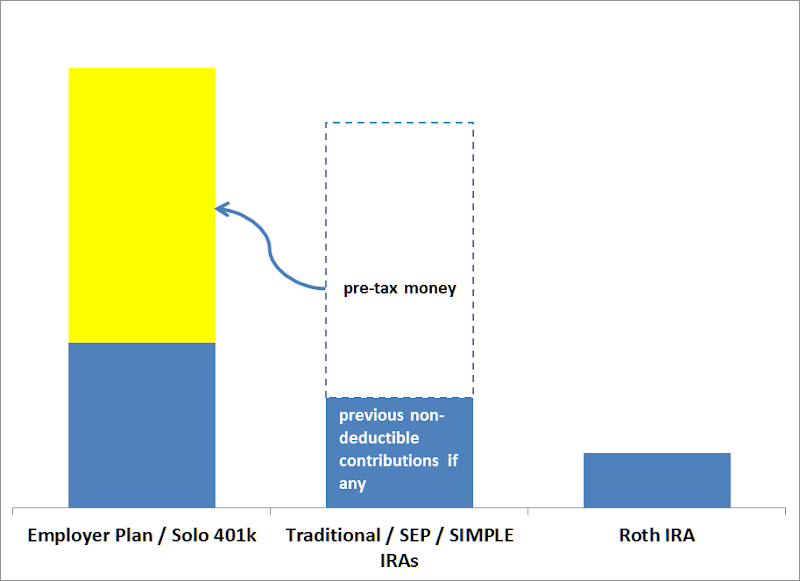
Step 1 – “Hide” other IRAs
If you don’t have any traditional IRA (say as the result of a rollover from a previous 401k or 403b), SEP-IRA, or SIMPLE IRA, you are in good shape. Skip to step 2. If you are married, please note IRAs are owned by one and only one person. Each spouse should look at his or her IRAs separately.
If you have a traditional IRA, SEP-IRA or SIMPLE IRA, and you don’t mind converting all of them to a Roth IRA now, also skip to step 2. You will have to pay taxes when you convert those IRAs.
If you have a traditional IRA, SEP-IRA or SIMPLE IRA, but you don’t want to convert them and pay taxes at a high rate just yet, rollover all the pre-tax money to an employer sponsored retirement plan: 401k, 403b or 457. Most employer-based plans accept incoming rollovers.
Everything in the traditional IRA, SEP-IRA, and SIMPLE IRA, except any non-deductible contributions you made in the past, is pre-tax money. For example if your traditional IRA has $34,000 in it and you made $10,000 non-deductible contributions in the past, $24,000 are pre-tax money. Move $24,000 to an employer sponsored plan. If you never made any non-deductible contributions in the past, all $34,000 are pre-tax money.
If you’ve made non-deductible contributions to your traditional IRA in the past, a key requirement is that you leave enough money behind in the traditional IRA — at least equal to your past non-deductible contributions. Don’t cut it too close. Consider market fluctuations and leave yourself a small cushion to show that on the day the money goes from your IRAs to your employer plan, you still have slightly more money in the IRAs than your past non-deductible contributions.
If your plan doesn’t accept incoming rollovers or if you don’t like your plan, create some self-employment income and set up a solo 401k plan, also known as a self-employed 401k plan or individual 401k plan.
House-sitting, dog-walking, tutoring, helping neighbors set up computer equipment, etc. are all good ways to earn self-employment income. Remember you don’t have to make a living on it. You just need a little self-employment income in order to qualify for setting up a solo 401k plan.
Fidelity offers a free solo 401k plan. Don’t use Vanguard for this because Vanguard’s solo 401k plan doesn’t accept incoming rollovers from IRAs.

Step 2 – Make a non-deductible contribution to a traditional IRA
After Step 1, you either don’t have any traditional IRA, SEP-IRA, or SIMPLE IRA, or you only have a traditional IRA with non-deductible contributions in it (maybe plus a bit of earnings). You make a non-deductible contribution to a traditional IRA. As long as you have earned income, even if your income is “too high,” you can still make a non-deductible contribution to a traditional IRA.
The maximum contribution for 2010 is $5,000 per person if you are under 50. $6,000 per person if you are over 50.

Step 3 – Wait
The law does not impose any waiting period between a contribution and a conversion (step 4). However, some are concerned that if you convert too soon, it can be seen as an abuse.
There is no official guideline for how long you should wait. Some say a few days, some say 30 days, some say 6 months, some say wait until the next year. Pick a time you feel comfortable with.
Having the money sit in a traditional IRA for a short period of time is not going to kill you. The tax on the earnings won’t be much because you won’t have a lot of earnings.
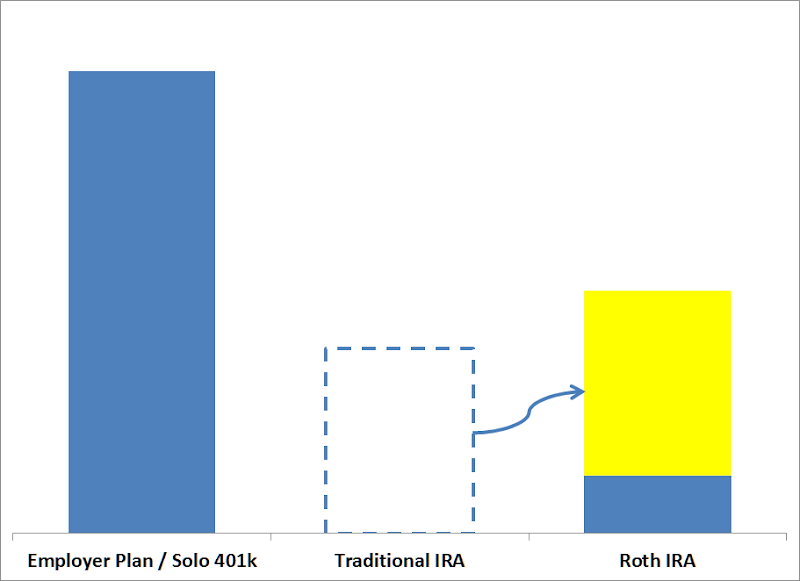
Step 4 – Convert the traditional IRA to Roth IRA
Ask your IRA provider how to do this. Some can do it online. Some will want a signed form. There is no income limit for the conversion. Because your Roth IRA conversion comes primarily from your non-deductible contributions, there will be very little taxes on the conversion.
Step 1 is necessary because if you didn’t do it, your conversion will be taxed by the percentage of pretax money in all IRAs (the “pro-rata rule”). Money in employer sponsored plans doesn’t count in the pro-rata rule.

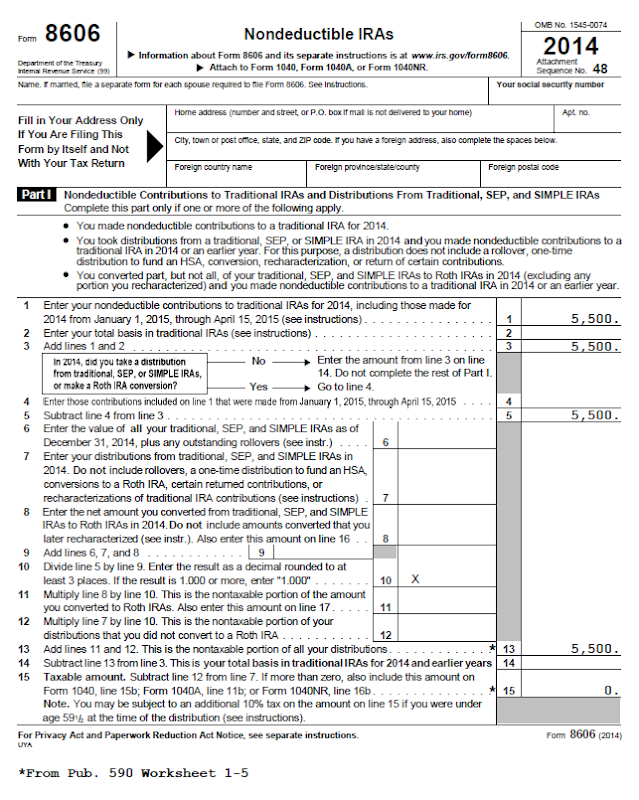
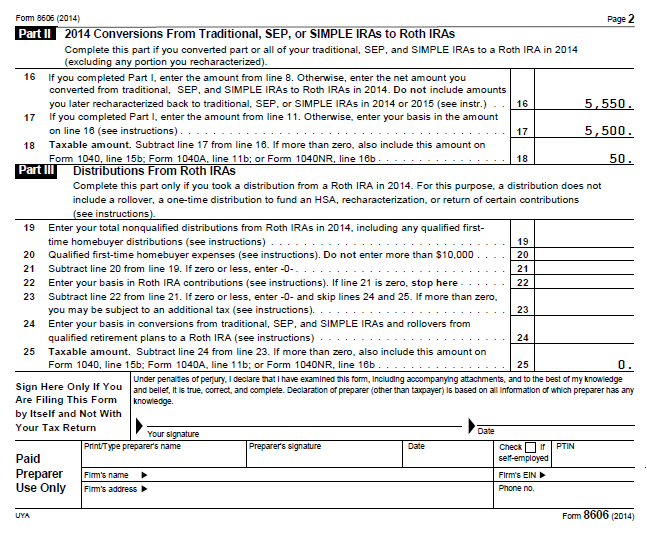
Step 5 – Include Form 8606 with your tax return
Since you made a non-deductible IRA contribution in Step 2, you will need to include Form 8606 when you file taxes. It’s a very simple form. If you use tax software, it will be included automatically.
Here’s an filled-out example.
Step 6 – Repeat Steps 2 to 5 next year
Step 1 is a one-time task. After it’s completed, you just repeat Steps 2-5 every year. Remember not to rollover from an employer sponsored plan to an IRA when you are doing the backdoor Roth IRA. You can rollover from one plan to another plan, or to your own solo 401k, just not to an IRA.
It’s too much trouble. Why don’t they just open the front door and let everyone contribute directly to a Roth IRA?
If the front door is wide open and everyone can contribute directly to a Roth IRA, the government will lose too much revenue. The income limit is imposed to reduce the revenue impact. Only those who know about the backdoor and are willing to perform the necessary steps can take advantage of the backdoor Roth IRA. Diligence brings rewards.
Will they close the backdoor?
While anything can happen, I don’t think the backdoor will be closed. The backdoor exists because the income limit for Roth IRA conversion was removed. Roth IRA conversion was extended to all income levels because the government wants revenue from the conversion. If you are afraid the backdoor will be closed, you should do it now, when the backdoor is still open.
[Last updated on Jan. 28, 2012, with a new step 3 (wait for some time between contribution and conversion).]
2.2% Rewards Card $444 Bonus
Earn 2.2% toward travel on all purchases with Barclaycard Arrival World MasterCard. No caps and no foreign transaction fees. 40,000 bonus points if you make $1,000 or more in purchases in the first 90 days. $89 annual fee waived in the first year (40,000 bonus miles pay for 5 more years after that). Learn More
Software picked, likely related posts:
- Recharacterize Backdoor Roth
- Inherited IRA and Roth Conversion Pro-Rata Rule
- Fiscal Cliff Deal and Backdoor Roth
Comments
221 Comments on Backdoor Roth: A Complete How-To
-
KD on December 20, 2010
Excellent article! I would like to see a graphic though. I know they are a lot of work to make.
-
Enonymous on December 20, 2010
Hmm
I have been doing this so far
But in 2011 doesn’t the income limit on Roths disappear…? -
Enonymous on December 20, 2010
Sorry!
I meant for conversions but this is exactly how effectively anyone can contribute to a RothThanks for your guide. I decided to just convert all Iras in 2010 spread taxes over 11-12 and then every year doing the nondeductible to Roth conversion
-
nickel on December 20, 2010
Just did this myself, including the Vanguard SEP-IRA to Fidelity Solo 401(k) bit. Excellent summary.
-
sc1 on December 20, 2010
If I skipped step 1, but already did Step 2 & 3, is it too late? Can I go back and do Step 1 if I do it before December 31?
-
TFB on December 20, 2010
@sc1 – In theory you should do Step 1 before you do Steps 2 and 3. In practice, I think you will be fine if you complete Step 1 before Dec. 31. Hurry up.
-
zany on December 20, 2010
Thanks for explaining this so well – while I have been doing this already, I am sure a lot of people will get help from the well written article.
Another relevant question – Roth is strictly better than a brokerage. Still any suggestions to what are the best assets to keep in that? I know you are a vanguard fan (like me) so it would be great to hear exact funds and ETFs.
And that said, ever thought about making your asset allocation public (sans the actual numbers)? It may help a lot of folks get some ideas.
-
CTG on December 20, 2010
In Step 1, please explain why the pro-rata rules don’t apply to the rollover. So if you rollover $24K to the employer sponsored plan, why is all $24K deemed pre-tax and not 24/34ths?
Also, I assume there is no need to make a non-deductible contribution in Step 2. You could simply rollover the after-tax amount left after Step 1 to the Roth, correct?
-
TFB on December 20, 2010
@CTG – Because the tax law says so. In IRS Publication 590 (p. 23 in the 2009 version), the IRS writes:
“Ordinarily, when you have basis in your IRAs, any distribution is considered to include both nontaxable and taxable amounts. Without a special rule, the nontaxable portion of such a distribution could not be rolled over. However, a special rule treats a distribution you roll over into an eligible retirement plan as including only otherwise taxable amounts if the amount you either leave in your IRAs or do not roll over is at least equal to your basis. The effect of this special rule is to make the amount in your traditional IRAs that you can roll over to an eligible retirement plan as large as possible. ”
In Step 2, although it’s not required that you make a non-deductible contribution, if you have earned income and you have the money, it’s better to do it before converting the traditional IRA to Roth. You will have more money in the Roth IRA that way.
-
TFB on December 20, 2010
@KD – Graphics? I will have to charge you extra for that.
Thank you for the suggestion. I added some graphics plus a sample filled-out Form 8606. How do they look? -
TFB on December 20, 2010
@zany – I shared my asset allocation some time ago.
-
KD on December 21, 2010
TFB, I think you have made quite a bit of money through my clicks on the amazon referral links. Graphics help understand this so much more quickly. Thanks!
-
TFB on December 21, 2010
@KD – I was wondering who bought a LCD TV off my Amazon referral links. Thank you.
-
nbollin on December 21, 2010
My wife has a SIMPLE IRA at work that she is currently contributing to; its value is about $10k. We are converting $8k from non-deductible iras ($4k each); and $3k from an old 401k (Trad IRA rollover) to roth IRAs this year. My question is the amount of tax due. Is the $10k from her simple ira factored in? Or do we just owe taxes on the $3k from the old 401k?
thanks -
TFB on December 21, 2010
@nbollin – It depends on who owns the $3k rollover IRA. IRAs are owned by one and only one person. Each spouse should look at his or her IRAs separately. If you own it, you will pay tax on that $3k. If she owns it, her SIMPLE IRA is factored in. The $7k conversion will have (3 + 10) / (4 + 3 + 10) = 76.5% as taxable. She will pay tax on $7k * 76.5% = $5,353 instead of $3,000. But then she will owe less tax from the SIMPLE IRA when she eventually takes money out of that or converts it to Roth.
-
Eric Forest on December 21, 2010
I still have a question regarding the solo 401k. can I set up a solo 401k purely to move IRA? I don’t think I will have any income from the self-employed category
-
Eric Forest on December 21, 2010
another question. I understand for 2010 the income limit for rollover to Roth is removed. But for 2011, is there an income limit for rollover to Roth?
Thanks
Eric -
TFB on December 21, 2010
@Eric – No, to both questions. You must create some self-employment income or move the pre-tax money in the IRAs to an employer plan. The income limit for Roth conversion is permanently removed, unless they reinstate it again in a new law.
-
Eric Forest on December 21, 2010
Thanks. I can not move the IRA to employer plan as I am currently unemployed. I guess my only options for converting IRA to Roth are 1) pay tax for the pre-tax money in IRA, or 2) find some self-employed income to create a solo 401k
If you have other ways, please let me know
Thanks
Eric -
TFB on December 22, 2010
Or just wait until you become employed again.
-
Eric Forest on December 22, 2010
sorry for the spam, but I have another question regarding the solo 401k. I decide to find some income from SE next year to do the IRA conversion. However, last night when I review the application forms for the solo 401k (from fidelity), I didn’t see there is a requirement to have some SE income to open such account. There is no mentioning of things like checking “pay check” for opening account (analogous to apply mortgage loan). I also can not find (although with quite minimum searching) any IRS restrictions regarding the need of SE income for solo 401k. can you point me to some links for those info?
Thanks again
Eric -
TFB on December 22, 2010
@Eric – Everything you read about 401k plans, including IRS publication 560, talks about an employer. A solo 401k plan is still a 401k plan. It just has only owners and their spouses as participants. Only an employer can set up a 401k plan, solo 401k included. The Fidelity solo 401k plan page says at the beginning:
“Self-Employed individuals and owner-only (and the owner’s spouse) businesses and partnerships can save more for retirement through a 401(k) plan.”
It doesn’t ask for proof but you have to put down an Employer on the adoption agreement. If you don’t have self-employment income, who’s the employer? How can you be an employer without income?
You don’t have to make a net profit but you must generate some income, at least in the year when you set up your plan. You can idle your business later and keep your plan but that’s another story. You want to be legit when you set up these things.
-
Eric Forest on December 22, 2010
Thanks for your great response. I think I can generate some income next year
Eric
-
JDB on December 24, 2010
The first step involves rolling over existing traditional IRA, SEP IRA or SIMPLE IRA but what if I already have a Roth IRA? I guess I don’t understand how I won’t avoid paying taxes twice if I convert my Roth IRA (which was funded using after tax money) to a 401K (which will be taxed when I make withdrawls later in life)? Thanks.
-
TFB on December 24, 2010
@JDB – Your Roth IRA is not an “existing traditional IRA, SEP IRA or SIMPLE IRA.” You do nothing to it in Step 1, as shown in the chart.
Wait until Step 3, when you convert the new/remaining traditional IRA with non-deductible contributions to the same Roth IRA account.
-
JDB on December 24, 2010
I see, so in my situation all I would need to do is open a traditional IRA, make a contribution, and then convert it to a Roth? Then repeat because next year I wouldn’t have a traditional IRA since I converted it to a Roth. Thanks.
-
TFB on December 24, 2010
@JDB – Yes, amazingly easy, isn’t it?
-
AB on December 24, 2010
My 8606 is identical to yours! (Except my investment gain is $100 rather than $20
I guess we did the same thing: opened traditional IRAs ahead of 2010 and funded them to the max with non-deductible contributions. (No other IRAs of any kind.) Net result: a good Roth balance able to grow tax-free forever. Looking forward to the 2011 conversion. -
dP on December 26, 2010
Can rental property income be considered “self income” for this purpose of opening a solo 401k?
-
TFB on December 26, 2010
@dP – In general, no. The IRS says if you provide substantial services to your renters, you can count rental income as self-employment income, but that also means you have to pay Social Security and Medicare taxes on your rental income. It’s not the best way to create self-employment income for this purpose.
-
anita on December 29, 2010
For step 1, I thought you had to have a ‘conduit ira’ to move money back into an employer plan. I.e. regular iras to which you made direct (pretax) contributions aren’t allowed for these kind of rollovers, right?
-
TFB on December 29, 2010
@anita – No, that was the old rule before 2002. Laws have changed.
-
Jay on December 31, 2010
TFB –
Great Post! Recently started reading your blog and found it to be very informative. No recycled posts and mostly original articles. Good Job!
I was regretting not contributing to Roth IRA when I started my career and the income was well below the limits. This post is a great solution.
I don’t have an IRA. Only 401(k). You dont have any timings in your post. Can you do this at any time of the year? Is there a limit on how long you need to have the IRA open before you can convert it? So for 2010, I can open an IRA, put $ 5000 in cash or money market and next day convert it? Are there generally any fees associated with it? Can I still do this for 2010 year?
I opened a deductible IRA for my wife couple of years back when I could. Now i am not able to contribute to that due to income limitations. Unfortunately I cant roll over to anything since we dont have any self income yet. But If I am willing to pay tax on the deductible IRA, can I still do this for my wife as well?
Last question. After conversion, the Roth IRA is the same as a “normal” Roth IRA?
Thanks
Jay -
TFB on December 31, 2010
@Jay – You asked great questions. Use this as the FAQ for this article.
> Can you do this at any time of the year?
Yes. Step 2, making a contribution has to be done April 15 of the following year, as usual.
> Is there a limit on how long you need to have the IRA open before you can convert it?
No. I converted mine the next day.
> Are there generally any fees associated with it?
Depends on the provider of course. In general, no. Many places don’t charge annual custodial fees either.
> Can I still do this for 2010 year?
Yes. You have until April 15 (or actually April 18) next year to make contributions. Conversion in 2011 counts as a 2011 conversion but it doesn’t matter. You just report the conversion on 2011 tax forms, instead of 2010 tax forms (contributions for 2010 are still reported on 2010 tax forms).
> If I am willing to pay tax on the deductible IRA, can I still do this for my wife as well?
Yes. After you pay the tax once, you get to do this for her every year thereafter.
-
Jay on December 31, 2010
Thanks for the quick answers….So if I understood you correctly, I can contribute say 5k in Jan for the 2010 year and 5K in Feb for the 2011 year, then convert the total 10K and claim the conversion in the 2011 tax form 8606. the 2010 tax form 8606 will only show contribution and no conversion…there is no limit on conversion so you can do that whenever you want (though you would not want to take the risk in case they change the rules on conversion)
Thanks
-
TFB on December 31, 2010
@Jay – That’s correct. If you have the money, you can also contribute $5k for 2010 and $5k for 2011 on the same day in Jan. 2011, and then convert that $10k the next day. I forgot to answer your final question in the previous comment.
> After conversion, the Roth IRA is the same as a “normal” Roth IRA?
You can use the same account. The converted money has its own 5-year holding period. For normal contributions, the 5-year holding period starts when the very first contribution was made. For converted money, the clock follows each conversion. If you are investing for long term, this 5-year thing doesn’t matter.
-
Brian on January 7, 2011
TFB, great article. I’ve already kicked off the process for step one to move my IRA money into my employer 401(k). Question about the Step 5….seems like if I did this for 10 years I’d end up with 10 Roth and have to open a new IRA each year or can I just roll-over the IRA funds I contribute for that tax year into the same Roth account I opened in year 1 and not close out the IRA account?
-
Lucy on January 13, 2011
Regarding hiding roll-over IRA’s before doing the backdoor Roth conversion–Must this be done if you just open a new non-deductible IRA account? I was thinking I could leave my roll-over IRA alone, open a new IRA account, fund that for 2011 and then convert just that account to the Roth. Would this work or would I still be taxed on every non-Roth IRA account I have?
Thanks for your excellent site!
-
TFB on January 13, 2011
@Brian – You can use the same traditional and Roth IRA accounts. Every year you add money to the traditional IRA you used last year and you convert it into the same Roth IRA you already have.
@Lucy – Step 1 must be done if you already have a traditional (including rollover) IRA and you want to minimize taxes. Otherwise your conversion will trigger the pro-rata rule and you will pay taxes.
-
Allen Anderson on January 15, 2011
I would like clarification on this subject. If a person makes a non-deductible contribution to his traditional IRA on January 18, 2011 (for tax year 2011), can he convert it to a ROTH IRA on January 19, 2011. In other words does the money need to stay in the traditional account for a specified time period before it can be converted?
-
Matt on February 8, 2011
Thank you for the informative article as always. I want to perform your steps now but I have a question about the timing of Step 1. If I rollover my pretax IRA money to my current employer 401k, I need to understand the timing. If I plan to make a $5k T-IRA contribution in Feb. 2011 (to count for 2010), what are the dates I need to commit the pretax IRA money rollback? If I understand correctly, Dec. 31st 2010 is the only date the IRS is concerned about so I could rollback to my 401k Dec. 30th and roll-in to my T-IRA Jan. 1st. If this right, did I miss the opportunity?
-
TFB on February 8, 2011
@Matt – No you didn’t miss the opportunity. You can rollover the pretax portion of the IRA to your 401k at any time, whether before or after you make the traditional IRA contribution. The only requirement is that you rollover (step 1) before you do the conversion to Roth (step 3). Between steps 1 and 2, it doesn’t matter. Doing it as outlined here, step 1 before step 2, makes it more streamlined. It’s also easier to understand because step 1 is one-time and steps 2 to 4 are repeated annually.
-
Matt on February 9, 2011
Thanks for the info. Step 6 on Form 8606 is confusing then. Step 6 reads:
Enter the value of all your traditional, SEP, and SIMPLE IRAs as of December 31, 2010, plus any outstanding rollovers (see instructions)That statement would make it sound like Dec. 31st 2010 is the only date that matters. When I read the instructions for Form 8606, this is the only comment I could find that might explain why I can roll my pre-tax IRA money back to my 401k at any time. Is that right?
Form 8606 Line 6 instructions (excerpt)
Note. Do not include a rollover from a traditional, SEP, or SIMPLE IRA to a qualified retirement plan even if it was an outstanding rollover.As far as step 1 being one-time, this would mean I would have to stay with my 401k investment choices once the pre-tax money was rolled back in. I was hoping to roll it back to my T-IRA so that I can use the IRA investment choices. Of course, I would need to repeat this every year along with steps 2-4.
-
TFB on February 9, 2011
@Matt – When I wrote the article, it was still 2010. The sample filled out 8606 form I provided was for all steps completed before 12/31/2010. If you are filling out the form for 2010 now, not having done the Roth conversion in 2010, you would answer ‘No’ to the question after line 3 and skip the rest of part I as instructed. By the time you do the 8606 form for 2011, line 6 will change to December 31, 2011 and you answer will be zero because you cleared out your traditional IRAs already.
Yes if you are going to do this, your pretax money will stay in your 401k. Rolling it out to an IRA will defeat the backdoor Roth. You will have to decide if you can live with the investment choices in your plan.
-
Matt on February 9, 2011
I now see your point about skipping the rest of Part 1. Here is my tentative plan:
-Contribute $10k Feb. 2011 ($5k towards 2010 and $5 towards 2011).
-Anytime before Dec. 31st, 2011, roll all my pre-tax IRA money to my employer 401k
-Anytime after Jan. 1st, 2012, roll my pre-tax IRA money back to a T-IRA
-Repeat steps contributing $5k during the tax year for that tax year.This keeps the pre-tax money non-taxable for Form 8606 and allows you to use your IRA during the year. This is a hassle but allows me to contribute to the R-IRA while still utilizing my T-IRA for pre-tax money. Please correct me if I am missing something.
-
TFB on February 9, 2011
@Matt – Provided your 401k lets you roll out money you previously rolled in, your plan will work but I wouldn’t do it if I were you. Rolling into and out of a 401k plan has to be in cash. Every time you do it, you will have to sell the investment and redeploy the cash when the rollover is complete. I don’t think it’s worth doing it back and forth every year just for the investment options. If you don’t like the investment options in your 401k plan, take a serious look at creating some self employment income and setting up your own solo 401k plan, as I mentioned under step 1.
-
Matt on February 10, 2011
@TFB – I am 27, in the 28% Fed. tax bracket and living in CA. Based on your articles and most of what I have read, I should contribute to a traditional retirement accounts rather than Roth. If I try to keep all my trad. assets in my current T-401k, my only IRA assets are R-IRA from the after-tax non-deductible contributions (including any previous Roth investments). This means most of my retirement portfolio will be utilizing whatever options I have in my T-401k through my employer. It doesn’t allow me to follow a ETF portfolio by Paul Merriman for example. I want to avoid opening up the solo 401k since I don’t currently generate side income. If I follow my method, I also have the possible ETF transaction fees twice/yr for moving to my T-401k and back. I’ll look more into the pros/cons of these various methods. Thanks again for your advice and educational articles!
-
christy on February 15, 2011
Great article. I have slightly different twist to the question. I received from 1099-DIV for my taxable investment account which I would have to report as taxable income on my return. Now if I were to open a Roth IRA now and move my money from the investment account into the Roth IRA with the purpose to count as my 2010 contribution, could I technically avoid reporting the dividend as income on my 2010 tax return ? I don’t have IRA of any kind at all, just my 401k.
-
TFB on February 15, 2011
@christy – No.
-
Cheri on February 18, 2011
I am curious how an inherited IRA would factor into a conversion, if at all? I am considering this option for 2011, but if I need to include the value of the inherited IRA for conversion, It wouldn’t be viable option.
-
Seth on March 25, 2011
TFB,
Thank you for a GREAT article. I wanted to contribute to Roth but did not know how to handle my existing deductible contributions. Step 1 takes care of that.
One question though:
I checked Publication 590 on IRS website which talks about this special “pro rata” rule that you are taking advantage of BUT, this rule applies to –
“Tax treatment of a rollover from a traditional IRA to an eligible retirement plan other than an IRA”
and the definition of Eligible retirement plans is given as (listed below). It does NOT list 401K as an eligible retirement plan… so how can one hide their deductible IRA funds in 401K and still take advantage of this rule?
The following are considered eligible retirement plans.
-Individual retirement arrangements (IRAs).
-Qualified trusts.
-Qualified employee annuity plans under section 403(a).
-Deferred compensation plans of state and local governments (section 457 plans).
-Tax-sheltered annuities (section 403(b) annuities). -
TFB on March 26, 2011
@Seth – A 401(k) plan falls under “qualified trusts.”
-
Seth on March 26, 2011
Thank you, TFB. You have a great site !!
-
Mike on March 29, 2011
Hi, quick question – why is step # 1 needed? Even if I have deductible contributions in my traditional IRA, if my preference is Roth over Traditional, why would I not want to convert all of my Traditional IRA to a Roth? I know this will result in paying taxes on that conversion for contributions (plus any returns) that were not previously taxed, but the benefit is that I won’t pay any taxes on the withdrawal (whereas if I left it in the traditional, I would need to pay taxes on the withdrawal). This is the same exact trade-off between roth vs. traditional in the first place, and if I prefer roth, I don’t understand why step # 1 would be recommended.
-
TFB on March 29, 2011
@Mike – Step 1 is needed for those who don’t prefer Roth over Traditional deductible contributions but prefer Roth over Traditional non-deductible contributions. If you prefer Roth regardless, you would’ve converted all your IRAs already and have no balance left when you come to this point. In such case, proceed to Step 2.
-
Mike on March 29, 2011
Thanks! I don’t think it’s possible for anyone to prefer traditional non-deductible contributions over roth as that wouldn’t make any sense, right?
This article is about getting around income restrictions for roth ira contributions. If so, most ppl would not have converted all IRAs and had no balance left at this point – your article very well explains how to do so for those ineligible to contribute directly to a roth, but you may want to list step # 1 as optional for those who prefer roth over traditional deductible.
-
TFB on March 29, 2011
@Mike – I added a paragraph under Step 1. By any chance have you read my article The Case Against Roth 401k? It gives reasons why you might not want to convert your traditional deductible balances now. Of course if you still prefer to convert, step 1 would be optional.
-
David on April 5, 2011
Thanks for the great article. I started this process a few days ago with Fidelity and I’m now at the point where I’m doing the conversion. It’s all very simple as you suggest but I do have one question: during the conversion, Fidelity is asking me if I want to leave the new Traditional IRA open or close it (since I’m converting my entire balance). Since I plan on doing this in future years, I was inclined to leave the Traditional IRA open. However, if I think I may want to rollover a 401k in the future due to a possible employment change, wouldn’t it make sense to close the Traditional IRA now, presumably leaving open the option (if necessary) of doing a rollover from my current employer 401k to a Traditional IRA in the future? Is there any reason why I can’t open and close a Traditional IRA every year (which is easy enough to do with Fidelity)?
-
TFB on April 5, 2011
@David – Just leave it open with nothing in it. You will need it next year. Leaving it open won’t affect your potential rollovers in the future in any way. You can roll into the empty one if you want, but read the paragraph under step 5 again if you plan to do this backdoor Roth every year.
-
David on April 5, 2011
I assume the language in step 5 you’re referring to is this: “Remember not to rollover from an employer sponsored plan to an IRA when you are doing the backdoor Roth IRA. You can rollover from one plan to another plan, or to your own solo 401k, just not to an IRA.” Just to make sure I understand, let’s assume I leave the IRA open with nothing in it and that I plan to do this backdoor Roth every year. Let’s also assume that I leave my current employment to start my own business and want to roll over my 401k upon my departure. Do I then understand that I would need to roll the old employer-sponsored 401k to a a new 401k (perhaps a solo 401k) but that I wouldn’t be able to roll over into my Traditional IRA? I assume that’s what your language in step 5 means but that seems to be a bit in conflict with your last comment that I “could roll into the empty one” if I want.
-
TFB on April 5, 2011
@David – Not that you wouldn’t be able to, but you probably don’t want to if you are still doing the backdoor Roth. Once you have 401k rollover money in a traditional IRA, you are back to step 1 again if you are still doing the backdoor Roth. If you are done with backdoor Roth, however, say because the income limit is raised and you can go through the front door, then it won’t be a problem rolling into the empty IRA.
-
David on April 5, 2011
TFB: Thanks as always. By the way, for those looking to do this quickly for the 2010 tax year, I just did this online via Fidelity and the whole process could not have been simpler.
-
Susan on April 18, 2011
TFB: I just opened a Trad IRA with Schwab today for tax year 2011. I funded it with $5000 immediately. Now the money is sitting in MMF. Shd I convert the MMF or buy stocks and convert?
Thanks -
TFB on April 18, 2011
@Susan – Convert the MMF. It makes your 8606 form clean. No gain or loss.
-
Susan on April 19, 2011
Thanks so much TFB! Love your blog!!
-
Craig on May 12, 2011
Great advice. My question is do you end up with several Roth IRA accounts if you take this approach? Once you convert the IRA to a Roth then repeat yearly, don’t you end up with a Roth IRA account for every year your convert? Seems like that would get complicated accounting-wise.
-
TFB on May 12, 2011
@Craig – When you convert, you convert into an existing Roth account. After you convert, you leave the empty traditional account open. Next year contribute and then convert. Just two accounts at all times.
-
Eyebeem on May 24, 2011
Hi…I followed your process but screwed up on Step 1. I cut it a bit too close and did not leave enough in my traditional IRA. My total non-deductible contributions to my traditional IRA are $23,000. On the day I transferred all of my deductible contributions ($12,500) out of my traditional IRA into my employee sponsored 401k, my traditional IRA was only worth $22,869. I was short by $131.
What will the impact of this be come tax time? Is there anything I can do to fix this at this point? I have already converted my traditional IRA to a Roth IRA (step 3).
-
TFB on May 25, 2011
@Eyebeem – Most 401k plans allow rolling out what you just rolled in. If that’s the case for your plan, you can pull the rollover out, do the correct math, roll a smaller amount back in, and convert the remainder.
-
Eyebeem on May 25, 2011
Thanks for the reply TFB. I was hoping that the tax implication of being off by only $131 would be minimal so that I didn’t have to go through rolling it back and forth again. Any idea how I would figure out what the tax impact would be of just leaving it alone?
-
TFB on May 25, 2011
@Eyebeem – If you’d rather not do it over, I’d think you will have to forfeit $131 basis. In other words when you file Form 8606 for your Roth conversion, you claim only $22,869 in basis instead of $23,000. Essentially you pay tax twice on $131. I’m not sure how IRS will view that discrepancy.
-
Eyebeem on May 25, 2011
Thanks…that makes sense. I am not going to sweat paying taxes twice on $131. Appreciate the advice!
-
SK on June 5, 2011
Hi – The information is great !! two questions:
1. I want to confirm that this backdoor option continues to be available for year 2011 i.e. I can non-deductible put $5000 in traditional IRA (I max out my 401k ) and then convert it to Roth IRA.
2. Do I have to wait for some time before converting the 5K in traditional IRA to Roth or I can do so the next day itself ? -
TFB on June 9, 2011
@SK – Yes, it’s still available in 2011 and every year thereafter unless the law changes. You can do it the next day.
-
DG on August 20, 2011
Great info! I recently left a company and had my 401K with both deductible and non-deductible contributions included over the years. In doing a rollover after termination, the large 401K company rep specifically didn’t recommend moving the non-deductible contributions directly to a Roth IRA in light of the IRS being unclear in this regard on it being taxable or not, so I basically moved forward and converted both the deductible and non-deductible contributions to a traditional IRA figuring I still had the non-deductible contributions growing tax-deffered.
In retrospect though, after reading various posted info on the web I believe I could have simply converted the non-deductible contributions directly to a Roth IRA and the pre-tax directly to the TIRA. In speaking with the 401K company two weeks after the conversion they indicated they cannot change it at this point. The non-deductible basis is only 3.5 percent of the total amount; however, the overall is too high so I surely don’t want to incur the pro-rata clause in any Roth IRA conversion but I am looking at my options as I do like the tax advantages of paying no taxes going forward on the earnings from the non-deductible contributions if in a Roth IRA.
So bascially the only options I have at this point is to to look to go to a new company and roll over the pre-tax contributions to a company 401K leaving behind the non-deductible as outlined in Step 1 or get some self-employment income and set up an individual 401K?
-
TFB on August 20, 2011
@DG – That’s correct, as explained in Step 1.
-
DG on August 20, 2011
Thanks TFB, just wanted to confirm that there was no other option at this point. Do you also think I could have went directly from the 401K plan with the non-deductible contributions to a Roth IRA with the before tax to a TIRA without any concern for pro-rata tax consequences? If that is the case, it is frustrating that they advised against it and I now have to jump through hoops to make this happen. Thoughts?
-
TFB on August 20, 2011
@DG – There’s a rule that says if you do two distributions from a 401k plan account (one to traditional, one to Roth), both are deemed as having a mix of pre-tax and after-tax contributions. A plan administrator that strictly follows this rule can’t just split off your after-tax contributions and roll it over to Roth, although I’ve heard some administrators would do it. If your plan administrator knows the rules and insists on tagging the dollars as part pre-tax part after-tax, I wouldn’t blame them — they are just following the rules.
-
Andy K on December 28, 2011
So here’s my situation: I have a Solo 401k from Fidelity which I max out, wife has 403b – also maxed. We both have a ROTH IRA the we contribute to monthly and no traditional IRAs.
As our incomes fluctuate by quite a bit, sometimes we hit the Roth IRA contribution threshold and sometimes we do not… often not knowing until the end of the year.
So – we will hit it this year and each have $4k already in a ROTH. How do we work this? Do I convert the money from the ROTH this year into a traditional non-deductible IRA and then 8086 it back into a ROTH again?
I’m not sure how to use your approach when we’ve already been contributing to this ROTH all year long? Either way, moving forward, I assume we ought to not dollar-cost-avg into these ROTHs from day one?
Thanks,
Andy -
TFB on December 28, 2011
Andy – If you find yourself ineligible to contribute to a Roth IRA due to income but you already did, you will have to do something about it. The easiest way would be *recharacterize* your Roth contributions to a Traditional IRA. Contact your IRA custodian. They may do it for you over the phone or have you sign a form. After that, you can convert the Traditional IRA to Roth. In the future, it’s just easier to contribute to a Traditional IRA in one lump sum and then immediately convert it to Roth. That way you don’t have to worry about whether you exceed the income limit or not.
-
SS on December 30, 2011
Great article. i do have a Traditional IRA with multiple Rollovers, deductible and non-deductible contributions and I have a question on Step 1.
My employer’s 401K allows incoming rollovers but here is my dilemma. My non-deductible contributions (a total of $13K) for previous years are across 2 different Traditional IRAs with 2 different companies. For eg: IRA 1 – $5K and IRA 2 – $8K.
But the current balance on IRA 2 account is only $5K due to losses over these years.
So when i implement Step 1, can I rollover less amount from IRA 1 to my 401K plan, so that I can compensate for the $3K loss that i incurred in IRA2 and effectively still try to Convert $13K to a Roth IRA Account?
Convert to Roth from IRA 1 – $8K ( Even though the non-deductible contrib is only $5K to this account)
Convert to Roth from and IRA 2 – $5KI am trying to understand if there are any restrictions as to the amount that can be converted as Roth IRA specific to an account or as long as these were non-deductible contributions, we are okay?
Thanks
-
TFB on December 30, 2011
@SS – The IRS considers all your IRAs, regardless of custodian, as one big pool. As long as you keep $13k in your IRAs after rolling over to your 401k, you are ready for the next step.
-
David on January 3, 2012
TFB: I did the backdoor Roth in early April of 2011 for the first time, depositing 10k into a non-deductible IRA and then converting. Due to some bad timing with investing the ROTH in Vanguard’s international REIT ETF (VNQI), I now show a 19-20% loss in that account. Does that change my strategy at all for this year? Is there any way for me to deduct those losses?
-
TFB on January 3, 2012
@David – Sort of, but it may not be worth it. Assuming you did it by the book and completed Step 1 before you made the contribution and the conversion, you can undo the conversion by recharacterizing it back to a traditional IRA. After that, you can take a distribution of the entire amount. If the distribution is less than your basis, you can deduct the loss.
However, the deduction is a miscellaneous deduction, subject to the 2% AGI floor when added to your other miscellaneous deductions. Unless you already have some other miscellaneous deductions, the loss is probably less than 2% of your AGI. That means you can’t deduct it after all. To me, it’s not worth it.
See Recognizing Losses on Traditional IRA Investments in IRS publication 590.
-
David C on January 26, 2012
FYI there is an interesting debate back and forth over the legality of backdoor Roth IRA contributions: http://www.bogleheads.org/forum/viewtopic.php?f=10&t=89497
I doubt there will be a consensus unless the IRS issue a ruling… or Congress changes the law
Full disclosure: I’m “poor” enough that I can directly contribute to my Roth IRA so no worries for me
-
TFB on January 26, 2012
Thank you David. I read the discussion. I have a solution for it. I will post it next week.
-
SS on January 27, 2012
I have an IRA which contains a mixture of non-deductible contributions, deductible contributions and rolled over 401K monies from my previous employer. My current employer does accept incoming rollovers, but the incoming rollover form has a section, to describe the source of the funds being rolled over. The choices are, and i can only choose one of these.
1. Conduit IRA (Rollover IRA)
2. Non-Conduit IRA (Traditional IRA, Simplified Employee Pension plans (SEP-IRA), or a “SIMPLE” IRA distribution made more than two years from the date you first participated in the SIMPLE IRA)I am not sure how to classify my IRA which is a mixture as. And dont want to do a rollover which will then be deemed illegal and have tax consequences.
@David…Thanks.. read your article and now not sure if this Roth conversion is even worth the risk.
-
TFB on January 27, 2012
@SS – That would be non-conduit. For existing non-deductible money, there is no risk. The concerns raised only talk about fresh contributions. There is an easy way out no matter whether the risk is real or not. Check back on Monday.
-
JLW on January 28, 2012
I read through most of the comments, but may have missed it… let’s say I already have a Roth IRA (that’s the only IRA I have), but would like to DOUBLE my annual contributions using this method. Is that a possibility? It sounds like a great way to catch up a bit on missed years.
Thanks for the great article.
-
TFB on January 28, 2012
@JLW – No you can’t double your contributions because the annual contribution limit is shared between Traditional and Roth. That’s why the article said at the very beginning if you are able to contribute directly, this article does not apply to you.
-
Andrew on February 5, 2012
TFB – Great how to guide. There are few guides like this out there and we all appreciate your patience with us mere mortals
. Having said that, I have a few questions/comments after reading your article and having to search elsewhere for answers or confirmation of my understanding.There is no limit on how much one may convert from a traditional IRA to a Roth IRA, correct?
The conversion only affects the tax return for the calendar year in which the conversion was performed, correct? In other words, If I made a 2011 traditional IRA contribution back in 2011, there is no real rush for me to do the conversion in the next week before I file my 2011 taxes since it is already 2012, correct?
Along these lines, there is no pressing need to convert sooner than later, correct? The only downsides I see are paying taxes on growth of the IRA and the possibility that the IRS will close the backdoor. For example, if my IRA is filled entirely from non-deductible IRA contributions (say $11k, $10k of that being non-deductible contributions and $1k being growth in the fund), and if I am going to contribute another non-deductible $5k this year, there is no real downside to contributing $5k for this year during February and waiting to convert the whole deal (now around $16k) after a six months lapse of time (per step 3).
-
TFB on February 5, 2012
@Andrew – You understood it well. There is no limit on how much one may convert from a traditional IRA to a Roth IRA. The conversion only affects the tax return for the calendar year in which the conversion was performed. There is no pressing need to convert sooner than later, other than the factors you already noted. If you wait, and the $1,000 earnings grow to $1,100, you just have to pay tax on $1,100 instead of $1,000. You didn’t ask but there is no limit on the number of conversions in a calendar year either. So if you decide to convert your existing money now and do a second conversion later this year for your 2012 contribution, that’s fine too.
-
Martha on February 7, 2012
TFB, I have a SEP IRA and a Roth. This year we will be over the income limit to contribute to the Roth. I was considering the solo 401k, but then thought about this. Can I contribute each year to the SEP (20% of income, approx 18,000) each year and then convert it all to a Roth each year?
-
TFB on February 7, 2012
@Martha – You can but do you want to? A solo 401k would be more effective.
-
Martha on February 7, 2012
I was considering the Roth IRA instead of the 401k because in the case of emergency, the contributed portion of the Roth could be withdrawn without penalties. (I hope I never need that, but it is comforting to have it as an option). If I opened a solo 401k or a Roth solo 401k, that money couldn’t be touched until retirement, right? I am weighing my options on both- solo 401k (Roth or regular) vs convert all the SEP to a Roth IRA each year.
-
TFB on February 7, 2012
@Martha – If you want an emergency fund, set one up outside retirement accounts. Use retirement accounts for retirement. Paying tax on $18,000 every year in order to deal with an off-chance emergency doesn’t make sense. It won’t work anyway. Unlike direct contributions, taxable conversions are subject to early withdrawal penalty unless certain conditions are met. See Roth IRA Withdrawal Rules.
-
Martha on February 8, 2012
Thanks for pointing that out, I didn’t know that. I’m going to go with the solo 401k, thanks!
-
Jay on February 13, 2012
After the first conversion would i continue roll the new tradition IRAs into the same roth account every year?
-
TFB on February 13, 2012
@Jay – Yes, the same. When you convert, the money moves but the accounts stay the same. After you zero-out a traditional IRA, you can contribute to it again the next time, and convert again to the same destination. Just keep using the same accounts on both ends. Picture two jugs: you fill jug A, pour from jug A into jug B, fill jug A again, pour into jug B again, …
-
JLynn on February 28, 2012
I’m wondering if I need to wait to do the back door Roth until 2012. I made a nondeductible traditional IRA contribution for 2011 this week but I should be able to change that contribution to 2012.
You mentioned that you need to move your Traditional IRAs into your Single 401K. I did that last week. As of December 31, 2011 my balance in my Traditional IRA was 37,314.14. The form 8606 asks as of December 31, 2011.
Other pertinent facts: Max out Single 401K, 2011 AGI $450K, MFJ
Thanks,
-
TFB on February 28, 2012
@JLynn – Unlike contributions, which you can do *for* 2011 *in* 2012 before April 15, conversions go with the calendar year. If you convert in 2012, it will be a 2012 conversion, which you report on your 2012 tax return in 2013.
-
Greg on March 10, 2012
Thanks for the article.
I have a an IRA with pretax money currently. If I roll that over to my companies 401k plan right now, do I still have time to do this process with a 2011 contribution? Or did I need to get the rollover done prior to Dec 31st 2011 to ensure that IRA is “hidden”?
-
Greg on March 10, 2012
Let me clarify my question a bit better…
Currently I have a deducible (pretax) IRA, which was a rollover from a 401k at an old job.
I already found out that my current companies 401k accepts rollover IRAs, so my plan was to initiate a rollover of this untaxed IRA account into that 401k. Ideally, I’d also like to then make maximum nondeductible IRA contributions for both 2011 and 2012, with the idea that they can both be converted to a roth with no tax consequences.
Here’s my question:
Is it too late for me to do this for a 2011 contribution? In other words, did I need to have my old IRA rolled over in 2011 for it to be “hidden” with respect to a recharacterization? Or do I just need to assure that it is hidden prior to doing the recharacterizations in 2012?
Thanks!
-
TFB on March 10, 2012
@Greg – The contributions and the conversion are independent of each other. You can contribute now, regardless whether it’s for year 2011 or 2012, and convert later, after you move the pretax money to your 401k.
-
newaustin on March 11, 2012
Excellent article.
1. So, if our AGI is 167K (married-filing-jointly) 2011, can we just contribute directly to Roth IRA vs this back-door?
2. I have a Rollover IRA (IRA from 401k rollover form previous employer) – so – if I do a direct Roth IRA – Will I still have to pay taxes in my Direct ROTH? or, Do I have to still do Step 1 “Hide other IRA”? How will Form 8086 Line 6 will change IRA basis?
3. Do we need to file for 8086 for Roth IRAs also?
-
Alex on March 12, 2012
Hi there, great article.
One quick question. Do you know for Step 1, “hiding” my pre-tax IRAs, whether it is possible to do an in-kind rollover of the Conduit IRA to a Solo 401k? The reason is, I own a large number of stocks (bought under free commission promotion), which would be expensive to sell off.
I guess it’s really a two-part question. One, is it legal. And two, which custodians (Etrade? Fidelity?) actually can carry it out without screwing up.
Thanks
-
TFB on March 12, 2012
@Alex -Yes it’s legal. Fidelity did an in-kind rollover for me from IRA to Solo 401k. First you transfer your IRA in-kind to a Fidelity IRA if it’s not at Fidelity already. Then you write them a letter to transfer the holdings in-kind from the rollover IRA to the solo 401k account. Call their toll-free number for the solo 401k department for the required wording. You sign the letter twice: once as the IRA owner and the solo 401k participant saying you want to roll over; a second time as the solo 401k administrator saying you accept the rollover.
-
TFB on March 12, 2012
@newaustin – For 2011 the Roth phaseout starts at $169k for married filing jointly. If you are married filing jointly and your modified AGI is $167k, you are under the limit. You can contribute directly and not worry about anything in this article. Since contributions to a Roth IRA are made with after-tax money, yes you do pay taxes on the contributions but you don’t pay any more or any less whether you have a rollover IRA or not. You don’t need Form 8606 if you are contributing to a Roth IRA directly.
-
Akshay Nagoree on March 24, 2012
@TFB, – To Greg’s question, you mentioned that “contributions and the conversion are independent”.
Does this mean if you have deducible (Pre-Tax) IRA of 100,000 AS OF NOW.
1. You can still contribute non-deducible (post-tax) IRA of 10,000 (5,000 for year 2011 and another 5,000 for year 2012) before April 15 2012.
2. Later, convert deducible (Pre-Tax) IRA of 100,000 to 401k after April 15 2012.
3. Move non-deducible (post-tax) IRA of 10,000 to ROTH IRA after April 15th 2012.If above is true, what will happen to “pro rata” rule?
Because at step 2, one still has non-deducible (post-tax) IRA of 10,000 combine together with deducible (Pre-Tax) IRA of $100,000.For 2011 tax purpose, by when deducible (Pre-Tax) IRA should be rolled into 401k? Will it be by 31st Dec 2011 or 15th Apr 2012
–Akshay
-
TFB on March 24, 2012
Akshay Nagoree – (1) Yes. You will get to the picture before you do Step 1 in the post. (2) Yes, it’s called a rollover, not “convert.” See picture in Step 1 in the post. (3) Yes. See picture in Step 4 in the post.
The “pro-rata” rule comes in on December 31 in the year you convert to Roth, not at the time you contribute to a traditional IRA. In the scenarios you described, by December 31, you don’t have any pre-tax money in your traditional IRA any more. The deducible (Pre-Tax) IRA should be rolled into 401k before you convert the remainder to Roth.
-
David on March 29, 2012
Do you have a screen shot of page 2 of the 2010 8606 form available?
-
TFB on March 29, 2012
David – Click on the 8606 form image in the post. I updated the link.
-
David on March 29, 2012
Thank you very much for reposting. I appreciate the help and the information your site has provided for me.
-
Mike on March 30, 2012
Thanks for the article. I was under the impression that if my traditional, deductible IRA was under-water (hence, worth less than my contributions) then I could add $5k as non-deductible and convert ONLY that $5k to a Roth with no taxes. Based on what I’m reading, this is not the case. So if I have $50K in a deductible IRA and try to do all this, I’m going to have to pay some tax for this portion of the conversion.
My dilemma is step 1. I like have my rollover IRA in a fund (not my new employer 401k) b/c I can trade stocks and have ultimate freedom. My 401k restricts me so much, esp. on trading frequency, that’s it’s not worth it.
If I’m missing something, a reply would be awesome. Thanks.
-
Dustin on April 1, 2012
Thanks for the great article. For clarification on basis calculation, in 2010 I opened a traditional IRA and funded it with a 5K non-deductible contribution and then converted it the next day into my roth IRA. However, the value had gone down $10 during that day and so only $4990 went into my roth. Because I used all the funds from the traditional account, on December 31, 2010 my traditional IRA account value was $0. I do not have a $10 basis to carryover into tax year 2011 because it is now as if that traditional IRA account no longer exists… correct? I ask because the 8606 form states that I would have a basis of $10 (but it’s my understanding that you can’t have a negative or carryover a basis from an account with a zero balance). So when I do the same backdoor plan for tax year 2011, it’s as if I’m starting over with opening a new traditional IRA account and that past $10 has no relevance… does that seem accurate? Thanks again!
-
TFB on April 1, 2012
Dustin – I would think you still have $10 basis left but if you are willing to give it up, it’s only $10. Not a big deal.
-
RobertC on April 7, 2012
TFB, Sorry if you covered this above – if so I missed it:
I have a rollover regular IRA, and so does my spouse. If I rollover my regular IRA into the Federal TSP, I can then do a backdoor Roth without worry of aggregation?
Lets say I contribute $10K after I zero out my regular IRA by transferring to the TSP. My spouses IRA would not be aggregated and I would owe no tax if I immediately (after a few months) converted the $10K to my existing Roth?
RC
-
TFB on April 7, 2012
RobertC – That’s correct. I wrote under Step 1 “If you are married, please note IRAs are owned by one and only one person. Each spouse should look at his or her IRAs separately.” I assume when you said you would contribute $10k you meant $5k for 2011 plus $5k for 2012, not $5k for yourself plus $5k for your spouse. If you only transferred your own rollover IRA to the TSP, you can do the backdoor Roth but she still can’t if she still has her rollover IRA.
-
RobertC on April 8, 2012
TFB, Yes that woud be $5K 2011, $5K for 2012. Thanks for the response.
In follow-up, can I later transfer a portion from my TSP, identified as ‘contributions’ with no earnings, back to a new regular IRA, which I could then rollover in total to my Roth with no tax consequence?
Could this be done while leaving the earnings in the TSP?
-
TFB on April 8, 2012
RobertC – You can rollover from TSP directly to a Roth IRA without an interim stop at a traditional IRA. You can’t separate contributions and leave earnings behind but it’s also not necessary. All money in the TSP is pre-tax whether it’s from contributions or earnings, unless you are talking about contributions from non-taxable military combat pay or the yet to be implemented Roth TSP. If you rollover pre-tax money to a Roth IRA, you will pay tax. There is no advantage in separating earnings from contributions because they are both pre-tax.
-
David C on April 8, 2012
It’s not definitive (in particular we don’t get a name for the IRS spokesperson)… but then again I don’t believe TFB was really worried about the legality of the “backdoor” anyway:
“The Internal Revenue Service hasn’t raised any red flags on backdoor Roths that are properly reported on form 8606. According to a spokesman: ‘The law is pretty clear on this issue.’ ”
See also http://online.wsj.com/article/SB10001424052702304072004577325551162426954.html and http://www.bogleheads.org/forum/viewtopic.php?f=10&t=94372
-
John L. on April 9, 2012
I will be submitting an extension to file for my 2011 Federal income taxes, and expect to file in June of 2012. Am I allowed to do all of the necessary initial mechanics (roll my SEP-IRA into a 401(k), then set up and non-deductably fund the TIRA) between now (April 9, 2012) and when I actually file in June of 2012? And am I correct to assume that the conversion of the TIRA to the RIRA can happen more or less any time (with an appropriate delay) after the initial mechanics, regardless of when the tax return is filed?
-
TFB on April 9, 2012
John L. – If you are making an IRA contribution for 2011, you must do so before April 17, 2012. Otherwise everything can be done at any time in 2012, either before or after you file taxes for 2011.
-
John L. on April 10, 2012
TFB – Thank you. I funded two nondeductable TIRAs today, one for me and one for my wife (2011 and 2012 contributions, into a money market fund), but it will take a week or two for me to complete the roll-in of the pre-existing SEP-IRA into my work 401(k). Per your replies above, I presume that once this roll-in is completed, we can subsequently convert each TIRA into a RIRA (say, a few months from now), but is there a deadline for this conversion (Dec. 31, 2012)?
-
TFB on April 10, 2012
John L – You are good to go. There is no deadline for the conversion. If you convert before 12/31/2012, you report the conversion on 2012 return in 2013. Or you can wait for a clean slate until 2013 if you’d like. Then you would report the conversion on 2013 return in 2014.
-
John L. on April 10, 2012
One more question, please, about rolling-in my pre-existing SEP-IRA at Vanguard to my employer’s 401(k) at Fidelity. The Fidelity rep said this is acceptable to that 401(k) plan. In my SEP-IRA, the balance is of course comprised of the “basis” (contributions, made “pre-tax”) and there are tax-deferred earnings as well. This SEP-IRA began life in 1990, as a Keogh Profit sharing plan and a Keogh Pension plan at Merrill Lynch, both of which I then rolled over/converted in 2007 to the one SEP-IRA at Vanguard. I’ve contributed something every year since 1990 to these things, and only with a lot of work could I could figure out the basis. Can’t I just roll over the entire balance into my 401(k) at Fidelity?
-
John L. on April 10, 2012
OK, so one more question, and this time I mean it. I also have a Vanguard 403(b) from my previous employer, to which I have not contributed anything since 2008. Can I just roll-in my Vanguard SEP-IRA into this Vanguard 403(b) plan and save the trouble dealing with sending it to the 401(k) plan at Fidelity ? (Plus the investment choices are better in the Vanguard 403(b) plan).
-
TFB on April 10, 2012
John L – You have basis only if you contributed after-tax money. If it was all pre-tax, your basis is zero. Some plans only allow incoming rollovers if you are still a current employee. If the 403(b) accepts it, sure.
-
Paul G. on April 13, 2012
Awesome site! First, thank you! Second, is there a limit on conversions in 2012? I just opened a converted an IRA for the 2011 year, but the conversion will be taxed in 2012. I want to contribute another 5K for 2012. If I convert in 2012 (which I would plan to do), is that okay? I’ll have 10k of conversion in the same year. I think that’ll be fine, just wanted to check with the boss.
-
TFB on April 13, 2012
Paul G. – That’ll be fine.
-
Lisa on April 14, 2012
I opened a 2011 non deductable ira on 3/29/12 and was planning on doing a backdoor roth conversion early next year along with a 2012 non deductiable contribution to be deposit later this year as mention in your article. But because my company sold my part of the company to another company, this allow me to retire from my current company once I start working for the new company. Included in my penion is a lump sum along with a monthly payment. To avoid paying a penalty and taxes, I will have to roll the lump sum into an ira account. The question is – currently, I don’t have any ira. if I convert my 2011 non deductable ira to a roth before I roll my lump sum into an ira, will this be a clean conversion? If so, can I contribute my 2012 and convert both at the same time before I roll my pension into a new ira? Thanks!
-
TFB on April 14, 2012
Lisa – No it will not be a clean conversion because whether it’s clean is determined by the balance in the IRA at the end of the year, not at the time you converted. If you put additional pre-tax money into a traditional IRA in the same year, you will “taint” your conversion. That’s why I wrote under Step 6:
“Remember not to rollover from an employer sponsored plan to an IRA when you are doing the backdoor Roth IRA. You can rollover from one plan to another plan, or to your own solo 401k, just not to an IRA.”
Do you have to retire from your current company? Will you receive more if you wait? If not, see if you can rollover the lump sum into your new employer’s plan.
-
Tapan Karwa on April 16, 2012
Consider that I contributed $5000 for 2011 as non-deductible IRA contribution in Jan 2011. The money contributed in 2011 was used to buy stocks. That $5000 has become $6500.
In addition, consider that I contributed $5000 for 2012 as non-deductible IRA contribution in Jan 2012.
So, the total in that account will now be $11500.Can I convert the entire $11500 if I am willing to pay tax on the $1500 that has been earned? Note that $10000 is non-deductible IRA contributions and so I would have already paid tax on it.
Thanks.
-
TFB on April 16, 2012
Tapan Karwa – If this is your only traditional IRA (including SEP and SIMPLE) and you only made these two contributions, sure, just convert and pay tax on the $1,500.
-
bytre on April 16, 2012
As I understand it, I can contribute $5k for 2011 and $5k for 2012 into a new non-deductible IRA, and then convert to a Roth IRA paying only minimal tax on any gain from the $10k basis, given that:
1. our married joint income is above the roth limit
2. I contribute to a 401k at work
3. I do not have a traditional IRA in my name (although my wife has one)
4. I declare the non deductible contribution on my 2011 tax return, form 8606Does that sound right?
-
TFB on April 16, 2012
bytre – That’s correct, although if you contribute for both 2011 and 2012, you only report the $5k contribution on your 2011 return. You report the other $5k contribution and the $10k conversion on your 2012 return. The $5k for 2011 must be done by April 17, 2012.
-
bytre on April 17, 2012
Of course, thank you!
-
Sam on April 18, 2012
Hi TFB, Great article!!! It looks like if someone’s filing status is ‘married filing separately’, they can still benefit from this technique even though their income is not ‘too high’? The AGI limit for Roth is just $10,000. Your thoughts please?
-
TFB on April 18, 2012
Sam – Yes, for married filing separately, an income above $10,000 is “too high.” I added it to the post.
-
Dee on June 18, 2012
Thanks so much for writing the article. I already have a SEP IRA with Vanguard and I’m contributing to this account for current year of 2012. After reading your article I feel the need of setting up a solo 401k with Fidelity and then roll over the SEP to it (and then go with Step 2, 3…). My question is, would it be okay if I stop contributing to the SEP IRA and set up a solo 401K for the same business (and within the same year)? I talked with one of the representatives with Fidelity and she suggests to set up the solo 401k starting from next year. Can you please advise?
-
bytre on June 18, 2012
Can a nondeductible contribution be made by a nonworking spouse towards an IRA that we then convert as well?
-
TFB on June 18, 2012
@Dee – It’s OK to have both in the same year although it’s cleaner to have just one type of plan in any given year. If you set up solo 401k this year, just make sure you don’t go over the limit on a combined basis.
@bytre – Yes if the working spouse has enough earned income (> $12k) to make the nonworking spouse eligible for a contribution to a traditional IRA.
-
Dee on June 19, 2012
Thank you so much TFB! Today I talked with Fidelity about my situation and setting up a solo 401k. They told me that I will have to set up the solo 401k next year since I already contributed to the SEP this year. So now I plan to open a solo 401k in Jan 2013 and then roll over the SEP from Vanguard. After that I will make nondeductible contribution to a traditional IRA and convert it to Roth IRA before April 15th. I’m thinking that this can still be counted as the 2012 Roth contribution since it’s before April 15th. Can you please let me know if this is practical?
-
TFB on June 19, 2012
Dee – Yes that will work.
-
bytre on June 20, 2012
Great, thank you for the advice!
-
Thankful Questioner on June 24, 2012
TFB – Can I complete step 1 after step 3? On December 20, 2010 you said that theoretically step 1 should be done first, but practically it can be done afterwards, before the end of the year. But later (February 8, 2011) you mentioned that it is a requirement to do step 1 before step 3. Since I had not done step 1, and will do it now, after I had completed step 3 earlier this year, is this ok? Or do I need to undo step 3 by un-converting the Roth conversion, complete step 1, and re-do step 3? Thank you.
-
fan on July 1, 2012
TFB – Where are you? We need you…
-
Motts McGregor on July 17, 2012
TFB — great article and thread. I am Looking for reality check on how to do my slow-motion backdoor Roth IRA with no tax impact in 2012 with a focus on old IRA contributions, not 2012 contributions.
Current holdings are as follows:
Regular tIRAs: $130k ($25k basis in non-deductible contributions made from 2003-2008)
Rollover tIRAs: $60k (all pre-tax / deductible contributions made as employee, and kept separate)
Roth IRAs: current balance irrelevant to this case
Solo 401(k): current balance irrelevant (I own my business so I control this 401(k) plan)Step 1 — move Rollover assets into 401(k) plan. Easy. Just like you wrote about — very impressed with Fidelity’s knowledge here.
Step 2 — move deductible portion of Traditional accounts to 401(k) plan. Not easy. The assets have been mixed together so I need to determine how much I am allowed to move.
Is this as simple as subtracting the basis ($25k) from the total tIRA account value ($130k — but as of what date is this measured?) and thus determining that $105k is the deductible amount which can also be moved into the 401(k)? This doesn’t seem to properly account for value changes. If this is the case I’d be left with $25k of value in the accounts, all of which is non-deductible. Then,
Step 3 — Convert $25k of non-deductible contributions with no tax impact.
Does this seem right? Thanks.
-Motts
-
Greg on July 18, 2012
Does the tsp plan for (former) military employees qualify as a substitute for the 401k to transfer existing tIRA into?
-
TFB on July 22, 2012
Greg – Yes, TSP will work if you can rollover pre-tax money into it.
-
Lisa on July 22, 2012
TFB – Is following the order of the steps important, or I complete step 1 after step 3, in case I have not done step 1 originally?
-
bytre on July 24, 2012
TFB,
Any guidance on whether the contributory IRA should be rolled into a standalone Roth IRA, or a new independent one?
-
TFB on July 24, 2012
bytre – An existing Roth account will work just fine. Not necessary to create an independent one.
-
Carol on August 4, 2012
TFB,
If I already converted my post-tax traditional IRA to Roth IRA, can I still open a 401k to “hide” the pre-tax contributions? thank you.
-
JP on September 5, 2012
Great article. Too bad did not see it when doing my conversion and tax return for 2011. I had my own 401k, but my husband had employer ret plan (at current work) and Rollover IRA from prev job (all deductible). I opened 2 Trad IRAs (non-deductible) and converted them to ROTH. The problem I did not mention other IRA on 8606 (his Rollover IRA). I have couple questions.
1. As I understand i can recharacterize my husband’s conversion back from ROTH to T-IRA until Oct.15, 2012?
2. Can leave my conversion intact because I did not have any IRAs except 401k?
3. Also can I withdraw all contributions to his T-IRA, like it never happened before?If I do that I then need to file amended 2011 tax return. Should it be there any 8606 forms for his reharacterization? or because all his non-deductible contributions will be taken back, no 8606 is needed at all?
Thank you very much.
-
Tom in Fla on October 2, 2012
Great Post! Ive been unemployed for several years (no earned income) . I have a Roth IRA and a Trad-IRA. (I funded the Trad-IRA with aft-tax $) however when I was laid off 6 years ago, I rolled over my employer sponsored 401K into my Trad-IRA. Subsequently ~2% of my Trad-IRA are aft-tax $ (the remainder are pre-tax $ and gains) My sole interest in this is to get access to the after-tax $ in my Trad-IRA without penalty.
Question: How much lack of effort can I apply to generating self employment income in order to be eligable to open a Solo-401K? For example, if I generated $20-30 in scrap metal submissions with receipts would that be acceptable?
Once I completed such a Solo 401K conversion (which I only plan to do for a one-time reclaim of my Trad-IRA aft-tax contributions) Is there any restriction on converting the Solo-401K back to a Trad-IRA?
Hopefully Vanguard will change their policies, I have 2 Trad IRAs, the largest one is wtih Vanguard, the other with TD, the Vanguard Trad-IRA contains a high yield CD that doesnt mature until late 2013, I wouldnt sell it before maturity just for the sake of completing this excercise, so Id have to wait next year to execute if I went with the Fidelity .
Many thanks for your efforts!
-
Harry on October 2, 2012
Tom – If it’s only 2% of your traditional IRA, I don’t know if it’s worth the effort. This article is really about clearing the deck for ongoing contributions every year thereafter. I don’t recommend that you do a one-off self-employment. The income from self-employment doesn’t have to be high but it should be an ongoing effort.
-
Tom in Fla on October 2, 2012
Thanks Harry for the speedy response.
I can see why you would wave off executing these tax acrobatics for 2%. However it is ~$14K of my own aft-tax money. Its not urgent, but Ive got ~5years till Im 59.5 and then can take penalty free withdrawls from my IRA, I will probably have a use for the money before then. It irks me that I cant access this money (esp since I already paid taxes on it) . I could report a annual small amount (<$100) of self employment income. I obviously want to avoid the frown of the IRS, and as you imply , its probably not worth it for 2%.
I wish I had known this prediciment existed back when I rolled over my employer sponsored 401K. (a good advisory for those in the market today for a 401K roll-over)
Thanks again for sheding some light on this complex subject.
-
Carol on October 3, 2012
Harry, can i complete step 1 after step 3, if i have forgoten? thx.
-
bytre on October 4, 2012
FinaceBuff,
If I have a loss on my traditional nondeductible IRA set up for this purpose (I couldn’t stand to let cash sit there, and made a sub-optimal investment), does it matter if I sell the security (to “realize” the loss) or not, and just transfer it to the Roth IRA? I am assuming it does not matter as unless it is a gain, and that I can’t get any credit for the loss.
-
Harry on October 4, 2012
bytre – No it doesn’t matter whether you sell to realize the loss. The loss (excess basis) can be carried forward in case next time you get a gain when do the same thing.
-
Gene on October 7, 2012
First, great article! Sorry if I have asked a question already mentioned above (a lot to read), but in Step 2, you say to contribute to the traditional IRA (limit of $5k if under 50). But why would there be a limit? I thought the $5k limit is only to deductible traditional IRAs. If I understand correctly, isn’t there no contribution limit to non-deductible traditional IRAs? So could I contribute a higher amount, say $25k, and then convert to a preexisting Roth IRA I had created when I first started out?
Also, my wife does not have an IRA account, but she also has an old Roth IRA account. Via the backdoor, can I contribute some from my “IRA” account to my wife’s Roth IRA, or does it have to be from her IRA account? Many thanks for your help.
-
Harry on October 7, 2012
Gene – For someone under 50, the limit is $5,000 in 2012 whether it’s deductible or not (going up to $5,500 in 2013). She will have to do it from her own traditional IRA, not yours. Open one if necessary. Keep it open with $0 balance for the next year after you are done with the conversion.
-
Gene on October 10, 2012
@ Harry – Thanks. Also, I am trying to do Step 1, but have run into a snag. I have a rollover IRA (from 2 previous employers’ 401k plans) worth about $45k. Based on discussions here, I should rollver that over to my current employer’s 401k. But they do not take incoming rollover. So sounds like next step is to open a solo 401k plan. I do have side income but not much (under $400 for current year, so no SE tax). But I’ve already contributed $17k in 2012 to my current employer’s SEP 401k, so I don’t think I can make anymore 401k contributions this year. Then can I still open a solo 401k with no money and rollover the IRA? Will they allow a rollover if I haven’t even contributed? Or should I wait till 2012, make a 401k contribution into solo plan, then rollover IRA?
-
Harry on October 10, 2012
Gene – Although you can’t contribute as an employee, you can still contribute as an *employer*. See previous post Solo 401k For Part-Time Self-Employment. Rollover before making a contribution is fine. Employers have until tax time next year to make the employer contribution for this year.
-
Mike on October 19, 2012
Is there a limit on the number of times I can “open” a non-deductable IRA? I open the account, fund it, wait x amount of time, convert it to my roth ira account. Does this effectivly close the traditional ira account or is it still “open” with a $0 balance? DO I have to open a new account the following year? If so does Fidelity and such companies eventually cut you off from opening and closing so many accounts?
-
Harry on October 19, 2012
It’s still open with a $0 balance. Reuse the same account next year.
-
Ryan on November 12, 2012
Great article I appreciate your time on this I’m hoping you can clear one thing up for me. I currently have a sep-ira with ~$150k in it and a traditional ira with~$10k in it. The t-ira has been funded completely with non deductible contributions. So I transfer my sep to a solo 401k plan (im self employed). Then you say however much non deductible contributions are in my t-ira to leave that same amount behind in my t-ira when i do the conversion. I dont have any deductible contributions in my t-ira so should I leave behind ~$10k in my sep-ira? When I make my non deductible contribution for 2012 that will give me around ~$15k in my t-ira account. So when I do the conversion to the backdoor roth do I get to convert all ~$15k? When I do this process all over again each year do I still fund my sep-ira and then immediately transfer it to the solo 401k plan? Sorry if this has been covered I read through most of it and still haven’t seen an answer to my specific need. Thank you again.
-
Harry on November 12, 2012
Ryan – You see in the graph the Traditional, SEP and SIMPLE IRAs are all in one pile. You would leave behind the $10k in your traditional IRA and transfer 100% of your SEP-IRA. After you create your solo 401k, you no longer fund your SEP-IRA. Fund your solo 401k instead.
-
Don on November 25, 2012
I am 68 and retired in December 2010. My joint AGI with my spouse in 2011 was $228K and will be roughly the same for the 2012 tax year. I don’t see a decline in my AGI for the foreseeable future. In October 2012, I opened a rollover IRA at E*Trade and transfered $100K from my Federal 401(k) to this IRA (all funds as yet untaxed). In November 2012, I opened a Roth IRA with the same broker and rolled over all funds in the traditional IRA (now increased to $101K) into the Roth. I expect to pay taxes on all of these funds.
Have I broken any IRS rules for the 2012 tax year? Will I need to recharacterize any of these funds?
-
Harry on November 25, 2012
Don – It looks like you just did a regular Roth conversion. It has nothing to do with what’s discussed in this post. No you didn’t break any IRS rules. No need to recharacterize.
-
CoderDude on December 26, 2012
Any news on whether this is changing for 2013?
-
Harry on December 27, 2012
Although laws can change at any time, there is no indication this is changing in 2013.
-
Sara on December 29, 2012
Thank you so much for this incredibly helpful article! Since I just initiated opening a traditional IRA today (December 29) with a 2012 contribution that I will then back-door into a Roth IRA in early 2013, I was going to ask about which year’s taxes would include the traditional IRA earnings. However, I just finished reading the earlier comments, so have learned that the tax on earnings goes by calendar year, not contribution year. But the Form 8606 still goes with 2012 taxes, right? Thanks!!!
-
Harry on December 29, 2012
Sara – 2013 taxes.
-
indexfundfan on January 1, 2013
Those planning to do backdoor Roth should wait until the fiscal cliff deal is finalized. Apparently, the senate bill has some language, which at this point is not clear, that could potentially eliminate the backdoor Roth.
-
Harry on January 1, 2013
As I read it, the Senate bill as it’s written now does not affect IRAs. It only affects qualified plans, allowing more people to convert a balance currently in traditional 401k to Roth 401k within the same plan. The plan has to offer the Roth 401k option and probably must be amended to allow such conversion. Of course because everything is still in flux, it doesn’t hurt to hold off for a short while and see what comes along.
-
David on January 3, 2013
Harry, if I am 49 years old now but turning 50 during 2013, am I correct that I can fund my IRA with $6500 and then convert to Roth at any time this year (even before turning 50)? And am I also correct that for each year hereafter I will be able to fund it at this higher amount, or does my “catchup” end at some point?
-
Harry on January 3, 2013
David – Yes, if you are talking about funding the IRA for 2013 (not in 2013 before 4/15 for 2012 tax year). The catchup to a traditional IRA ends after you reach 70-1/2 together with your regular contributions to a traditional IRA. You can still catch up to Roth IRA directly after that if your income allows it.
-
William on January 3, 2013
Hi Harry,
Thanks for the great article. I funded a IRA for $5000 and then converted it last month. However, between the time of funding the IRA and converting it to a Roth I obtained some capital gains. The bank converted these funds into Roth also, making my total conversion over $5000. My question then, is do I need to get with the bank and withdraw this overage before tax cutoff time, or is it okay that I rolled over more than $5K since it was gains for the IRA. Thanks for your help! -
Harry on January 4, 2013
William – No need to withdraw. You just pay tax on the small gain.
-
Derek on January 8, 2013
Hi Harry. Great article. Question for you. In step 1 you say “If you’ve made non-deductible contributions to your traditional IRA in the past, a key requirement is that you leave enough money behind in the traditional IRA…” If I have ONLY made non deductible contributions can’t I convert the entire amount to a Roth and pay taxes only on the gains (opened in 2008 so not a lot of gains)? If this is the case should I contribute $5000 for 2012 to the existing account and then convert it all at once or convert the existing and then open a new traditional, add the $5000 and then convert? Thanks
-
Harry on January 8, 2013
Derek – Yes you can convert the whole thing if you have negligible amount of pretax money in it. You can just do one conversion for everything: old money plus 2012 contribution plus 2013 contribution (see picture in Step 4).
-
Misreporter on January 9, 2013
3 days ago I realised there is such a thing as backdoor Roth conversion from bogleheads forum and immediately opened one for my wife and myself. Then yesterday while simulating a 8606 filing I was making a very silly mistake which kept on bugging me till I landed on your website and voila! the filled in 8606 above was God sent. Thanks a lot for the article and everyone who has contributed to this forum.
On a separate note, I have a problem for which I seek some guidance – I just discovered that my Turbotax screwed up and instead of 20k reported 0 as my total basis in the 2011 tax return. I wish I knew abt significance of this form before. I have been filing 8606 in all my prev tax returns but the total basis in line 2 has not been correct/consistent. I have tax statements from my broker to prove what the correct total basis should be. As I want to do a backdoor Roth in 2013, what are my options? I havent yet filed the 2012 return obviously. All contributions in my tIRA are post tax (non deductible)..thankfully a plain vanilla situation.
-
Harry on January 9, 2013
Misreporter – If your previous 8606s were wrong, obviously you need to correct them. Because numbers carry forward from year to year, you want to trace back to the first year that was wrong and correct from there. After you have all the years sorted out, call the IRS and ask them how to send in the correct 8606s.
-
Misreporter on January 10, 2013
Thank you, Harry.
-
Sunil on January 11, 2013
TFB/others – Happy New Year ! Any word on changes in Backdoor ROTH as mentioned above due to the new tax law’s/changes announced on Dec 31st ?
Can we continue to put $5000 post tax funds in Traditional IRA and convert to ROTH (even for upper bracket income where ROTH is not available) ?
-
Harry on January 11, 2013
The new law brought no changes to converting IRAs. See Fiscal Cliff Deal and Backdoor Roth.
-
Victor on January 13, 2013
I have a little dilemma that I would appreciate your feedback on:
I have 1 active 401k plan that I contribute to from work and also 1 active SIMPLE from consulting work aside that I also contribute. I have 1 old SEP IRA plan that sits idle from prior job. I also have some nondeductible IRAs.
I don’t want to convert ALL pretax $ to ROTH but maybe around half of it.
These are my thoughts:
1. Find out if I can rollover my SEP IRA into current active 401k plan. If not possible, am I allowed or does it make sense that I stop contributing this year to my currently active SIMPLE IRA; open a new solo-401k for this consulting job on the side; THEN rollover both old SEP IRA + SIMPLE IRA moneys into it (effectively “hiding” my pre-tax $ in a new active solo-401k plan? The idea is to isolate my nondeductible IRAs and do the backdoor ROTH conversion.
2. Not sure if this is allowed, but another thought would be to somehow “change” (or convert/recharacterize…..not certain of the right term) current active SIMPLE IRA into a new solo-401k; then rollover the balance of this old SEP IRA; effectively “hiding” pretax $ but still have an open active pre-tax account that I can continue to contribute to for my consulting job. Then, backdoor convert to ROTH my nondeductible IRAs. Can this be done…?
Thank you for your suggestions in advance!
Victor
-
Harry on January 13, 2013
Victor – You have to stay in the SIMPLE IRA for two years (measured from the date you first made a contribution to the SIMPLE IRA). After that you can rollover the SIMPLE IRA to a solo 401k. See IRS Publication 590 Chapter 3 about rollover/transfer out of SIMPLE IRA. If it hasn’t be two years yet, just leave the traditional IRA contribution as non-deductible and wait it out.
-
Janet on January 24, 2013
Hi Harry:
On February 2012, I made a contribution into a Traditional IRA in the amount of $5K for tax year 2011. When I filed my taxes in 2011, I filed the Form 8606 for this $5K. In June 2012, I transferred the $5K to a Roth IRA. Now, I received a 1099-R for the transfer amount from the Traditional to Roth IRA. How do I handle this? DId I do something wrong? Please advise. Thanks so much.
Janet
-
Harry on January 24, 2013
Janet – Nothing wrong. Just fill out 8606 again for 2012 referring to your basis from your 8606 for 2011.
-
DC on January 24, 2013
Harry,
I have an old 403b and an old SEP IRA, as well as an active Roth(which I can’t directly do anymore due to income) and lastly a 401k at work. I would like to get set up to start a back door Roth. I want to roll my SEP into my 401k. Due I also need to roll my 403b over as well?
Also, I want to move my profit sharing aspects of my 401k into a different account/better account(with lower fees than offered by my employer plan), can I move the roll over portions that came from my SEP and 403b from my current 401k(if I roll those over to the 401k plan) to an outside account?
-
DC on January 24, 2013
Harry,
If I move the profit sharing aspects from my employer out of the 401k or “redirect” them elsewhere,
what kind of an account do they need to go? What is the account called, say if I move it to Fidelity or Vanguard?
Thanks. -
Harry on January 24, 2013
DC – No your old 403b can stay if you like it better than your active 401k. Whether you can roll profit sharing out of your 401k depends on your employer’s plan. The law allows it; your employer doesn’t have to allow it. Same thing to the money rolled into your 401k, although more employers allow rolling out money that originally rolled in than rolling out profit sharing money. However, if you roll out to a traditional IRA, it would defeat your backdoor Roth. So maybe do it only when you don’t need backdoor Roth any more. You can also potentially roll the SEP and the profit sharing money from your 401k into your old 403b. Again, the law allows it; your previous employer doesn’t have to allow it.
-
Gene on February 12, 2013
Harry,
In Dec 2012, I contributed $5k (non-deductible – total of $10k) to both my and my wife’s traditional IRA. The next day (still in Dec 2012), I had them converted into our respective existing Roth IRAs. So far, seems like no problem. Now I am doing my taxes for the year 2012. We received the Form 1099-R from our broker. As I enter the information into the tax software, it seems to want to charge taxes on the “distribution” from the traditional IRA. Then later in the program, it mentions that I should have a Form 8606. But I did not have any traditional IRAs at 12/31/2011, so I entered 0. If I do this, it wants to tax me on the conversions. But if I put $5k, then it doesn’t.I’m confused. Should I have physically done the conversion the following year (2013) to avoid taxation on the conversion then? I thought it did not matter when it was converted (i.e. next day). Thanks for your comments.
-
Harry on February 13, 2013
Gene – See if this article helps you: How To Report Backdoor Roth In TurboTax. If you use a different software, the principle is the same. You have to enter in two places: one place for the conversion (1099-R), another place for the contribution. Zero for the basis on 12/31/2011 is correct. You just have to wait until you enter your contribution in a different section later in the program. Software typically have you enter your income first, deductions second. When you only have the 1099-R part, it appears you are being taxed. The number will change after you enter your contribution. In my article I have you enter the contribution first, conversion second, which follows the natural sequence of events, but the software doesn’t do it that way if you only follow the software’s screen sequence.
-
Sally on February 17, 2013
Harry -
Thanks for the very helpful guide. This year we discovered that we have been doing the backdoor roth incorrectly for the past 7 years. (Our accountant never considered the value of our rollover IRAs on 8606) and we continued this pattern after we started doing our taxes ourselves. In essence, we have skipped step 1, but acted as if we did it, only using the basis as our non-deductible contributions. How do you advise we proceed now? Do we file amended returns for 7 years? Do we file things correctly this year? Do we continue our error (be consistent) one more time and then stop? Appreciate your advice if you are able to provide any.
-
Hieu on March 2, 2013
Hi, I would like to do a backdoor Roth for 2012 going forward. Here is my situation. I have a traditional IRA with Vanguard as well as a rollover IRA. The traditional IRA contains all post-tax contributions. The Rollover IRA contains pre-tax, deductible contributions as well as earnings and a small amount of post-tax, non-deductible contributions (I can’t recall how much post-tax money I contributed since it was done 2-3 employers ago and Vanguard doesn’t show it on my account). Can I do Step 1 by just moving the deductible contributions from my Rollover IRA to my current 401k plan (would I also have to include earnings?) and do nothing with my Traditional IRA or would I have to do something with my Traditional IRA as well? I don’t want to pay taxes on earnings from my Traditional IRA at this time. Thanks!
-
Dave on March 12, 2013
Assuming that you are able to contribute to a Roth IRA, is there any reason that you couldn’t also contribute to a non deductible IRA too? And then later roll the non deductible into the Roth. Thanks
-
Harry on March 12, 2013
Dave – The annual limit for IRA contribution is shared between Roth and Traditional. If you already contribute the maximum to Roth, you can’t contribute to Traditional (whether deductible or non-deductible).
-
BD on March 17, 2013
I’ve used the so-called backdoor Roth approach for two years and it was straight forward because I didn’t have any other IRAs to “hide”. However, I will be soon be the owner of a Beneficiary IRA and I don’t know how this may impact my ability or approach toward contributing to my Roth through the backdoor technique. Opinions/comments? Thanks.
-
Harry on March 17, 2013
BD – It does not affect it. See related post Inherited IRA and Roth Conversion Pro-Rata Rule.
-
JW on March 23, 2013
I am interested in doing a Backdoor Roth IRA, but am a bit confused. I exceeded the income limits in 2008 and 2009. Those years, I had contributed $4995 and $4995 respectively to a Roth IRA for my wife, but recharacterized them to a Traditional IRA (as a non-deductible contribution, I presume) each since I exceeded the income limits unexpectedly each year to late year bonuses. While the original contributions were those amounts, the actual recharacterization amounts to the Traditional IRA account was $3825.48 (2008) and $3175.70 (2009) due to losses those years. The current value of the Trad IRA is $10,825 (with the only money being the above as I described).
Q1: If I execute the recharacterization of this (back) to a Roth IRA, would tax be due and how would that all work? Would that be on the growth from $7001->$10,825 or the original invested amount of $9990->$10,825?
Q2: I exceeded the income limit in 2012 and will again for 2013, so I am interested in doing a backdoor for 2012 for $5000 and 2013 for $5500. Is it best to wait to do this after I clear up the above and do this in a second phase?
-
Harry Sit on March 23, 2013
Q1: The latter. Q2: I would do it all together.
-
JW on March 23, 2013
Thank you Harry/TFB for the answers to my question above. That is awesome. That scenario was for my wife’s recharacterization to a Roth IRA. I have a question about mine also if you would be so kind as to advise.
My Trad IRA contains a mix of a 401k that was transferred in from an old job in 2004 as well as the same two years where I exceeded the income limits in 2008 and 2009 and also 2012 (until I realized early on that I would exceed income limits). Those years, I contributed $4995, $4995 and $416.67 respectively to a Roth IRA, but recharacterized them to a Traditional IRA (since I exceeded the income limits unexpectedly each year due to bonuses), for a total of $10,406 in non-deductible contributions.
The current value of the Trad IRA is $24,700. I am not certain of the amount of the 401k transfer in or the cost basis of the 401k that was transferred. My best guess is that the value of the 401k transfer was ~ $9975 and the cost basis of the 401k that was transferred was ~ $6000 but it is just that, a guess.
Q1: Any advice on how to handle this one?
Q2: What do you do when you don’t have perfect cost basis records?
Q3: The tax rate on any gains would the the 15% capital gains tax rate, correct?
Q4: All of this is treated in separate buckets (wife and mine recharacterization), correct? -
Harry on March 24, 2013
JW – If your 401k from the old job was pretax money as most 401k’s are, you have zero basis in that money. So you have a $24,700 IRA with $10,406 in non-deductible contributions. If you have a place to “hide” the $14k difference, just follow the steps in the main article. Otherwise if you want to convert the whole thing you will pay tax on the $14k, as ordinary income, not capital gains. Yes yours and your wife’s are completely separate.
-
Bebe on March 26, 2013
This is great! I did not realize we could do this. Here is my situation:
I have a pre-tax IRA account with $9,000, I also have 2 non-deductible IRAs, one has $14,500 (with 12,000 basic) and the other has $12,000( with $11,000 basic).
I screwed up; I forgot that I had a pre-tax IRA, so I converted part of the deductible IRA to Roth last month before transfer my deductible IRA to 401K
Question #1 : Could I just go a head and transfer my deductible IRA to 401K now without re-characterize the Roth Account back to traditional? and hopefully, everything will resolve by the end of the year since I have done all of these this year.
Question #2: Here is what my friend and I have argued over (without looking at IRS rules). My friend thinks I could also transfer the earning of my non deductible IRA ($2,500 + $1,000) to my 401K and defer the tax liability; is he right? I am doubtful.
-
Ash on March 27, 2013
Hi Harry/TFB,
Me and my spouse are not eligible to make a direct contribution to ROTH IRA this year as our AGI is more than permissible limit. We decided to contribute to traditional IRA and convert it into ROTH IRA immediately within few days. How do we declare this on 1040 and 8606 form ? This is the first time we would be making any contribution to IRA and we both are not covered by any retirement plan by our employer
Assuming our total wages is $200,000 and each of us contribute $5000 to IRA and convert it immediately to ROTH with $0 earnings on it.
1. Form 1040: line 7 $200,000
1. Form 1040: Should we declare $10000 as deductible IRA on line 32 (As we are first making a contribution to IRA)
2. form 1040: Line 36 $10000
3. Form 8606 part 2, for conversion for each of us. Each form would like below ?
line 16: $5000
line 17: $0
line 18: $5000 (which would mean we need to declare this on form 1040 line 15b)
4. Form 1040: Line 15b $10000 for both of us. (Because of Line 18 on Form 8606)
5. Form 1040: Line 22 $210,000
6. Form 1040: Line 37 would be $200,000 (as $10000 is cancelled by line 36)Is that correct ? Do we need to fill part1 also ? if yes for each of us
7. Form 8606: Line 1 $5000
8. Form 8606: Line 2 $0 (Since we are filling it for first time)
9. Form 8606: Line 3 $5000
10. Form 8606: Line 14 $5000
Line3: In 2012, did you take a distribution from traditional, SEP, or SIMPLE IRAs, or make a Roth IRA ?
conversion?
Would answer be no to this ?Your help would be greatly appreciated.
Thanks,
Ash -
Harry on March 27, 2013
Ash – If both of you are not covered by a retirement plan at work, your contribution to a traditional IRA is fully deductible. At a high income level, I would just leave it like that and not convert to Roth. If you still want to convert to Roth, then your #1 – #6 are correct. The tax on the conversion washes out the deduction. Part I of Form 8606 would be blank.
-
Ash on March 28, 2013
Thanks Harry for getting back.
Why did you say this ? At a high income level, I would just leave it like that and not convert to Roth. any specific reason why we shouldn’t convert to Roth ?
-
Harry on March 28, 2013
Ash – Because you lose the deduction when you convert. People do the backdoor because they don’t get a deduction anyway when they are covered by a retirement plan at work. A deduction is very valuable at high income levels. See previous article The Forgotten Deductible IRA.
-
doug on April 3, 2013
Harry, I have tried to get an answer to this and haven’t been able to. I followed your steps last year for the first time, and I think everything went perfectly. This year, however, I am unsure my form 8606 is being filled out correctly. I have never owned a traditional ira before doing these backdoor conversions. Should my form 8606 look the same year after year? I thought that form 8606 was used to track contributions, but this year after filling out the form it looks exactly like last year, with no running tally. Is that correct?
Love the blog by the way!
-
Harry on April 3, 2013
Doug – It would look the same if you contribute for the current year and then convert in the same year. If you contributed in 2011 for 2011 (not contributing in 2011 before April 15 for 2010) and you converted in 2011, and if you did the same again — contributed in 2012 for 2012, converted in 2012 — then you 8606 would look the same year after year, except the annual contribution limit going up from $5,000 to $5,500 in 2013 (add another $1,000 if you are over 50). This is the cleanest way.
-
doug on April 3, 2013
That is my situation. Thanks a lot!! I spent hours trying to find that out on google. There is a lot of info out there on how/why to do a backdoor roth, but little on the actually filling out of the 8606 form.
-
Jon on April 3, 2013
I’ve read some speculation that Congress will close the backdoor Roth option soon to generate more tax revenue. I’d like to contribute now but don’t want to have to undo my contribution later this year. Anyone willing to speculate whether the backdoor option might go away?
-
Harry on April 3, 2013
Jon – Anything can happen when it comes to Congress, but if we are just speculating I would say any change will be effective in a future year, not retroactive for the current year.
-
James on April 6, 2013
Hi Harry/TFB,
I could not find the answer to my situation after searching for severl hours. Your help is greatly appreciated.
I filed my 2012 Tax in march and also received my refund. Only later after filing my 2012 tax, I came to know about back door roth IRA ( my income limits are high for direct IRA ) . So, I then contributed non-deductible $5000 in TIRA for year 2012 ( few days ago on April 1st ) .
As a result , my 2012 tax return does not reflect my TIRA contribution for $5000
What do I need to do correct this?
a. Should I report this by separately mailing 8606 form to IRS?
or
b. Should I amend my 2012 tax return with 1040X ( I used turbo tax ) and add this 8606 form in turbo tax?
or
c. Should I do something else ( if not a or b )note: If the choice is between a and b, I prefer b since I can e-file instead of mail.
Thank you in advance,
James -
Harry on April 6, 2013
James – Either (a) or (b) works. Because the contribution is non-deductible it doesn’t change anything else except the 8606. If you convert in 2013, the conversion will go on 2013 return you file in 2014.
-
James on April 6, 2013
Thank you Harry for the prompt response.I appreciate that.
-
Tina on April 8, 2013
Hi TFB,
I’ve done backdoor IRA in year 2010, 2011, and 2012. $5000 each year. What should my 8606 look like? e.g. should the field 2 be 10,000 and field 13 and 14 both be 15,000? In your filled-out example why is field 14 zero? Does this year’s field 14 number goes to next year’s field 2?
Thanks very much!!!
Tina
Tell me what you're thinking, but please don't spam. See comments moderation policy.