Healthcare.gov started the 2027 ACA health insurance open enrollment on November 1, and some state-run exchanges started sooner. It will be my 9th year on ACA health insurance.
ACA health insurance serves millions of people for many reasons. This post covers one group: retirees under 65 and people who plan to retire early. I dug up the premium history over these years. It revealed good learnings for early retirees.
ACA premiums have been climbing fast. After adjusting for general inflation, the full price for the benchmark Second Lowest Cost Silver Plan (SLCSP) in my area is up 43% since 2024, and the full price for the Bronze plan I buy is up 52%.
ACA Subsidy Cliff
Not everyone feels the large increases the same way. The ACA subsidy cliff, which returned in 2026, imposes a hard cutoff at 400% of the Federal Poverty Level (FPL). It splits participants into two groups. Below the income cutoff, a premium tax credit caps what you pay toward a benchmark plan as a percentage of income. Above it, you pay the full price. A $1 difference in income can gain or lose over $20,000 in tax credit. Here are the income cutoffs in 2027 based on the household size and the state:
| Household Size | Lower 48 States | Alaska | Hawaii |
|---|---|---|---|
| 1 | $63,840 | $79,800 | $73,440 |
| 2 | $86,560 | $108,200 | $99,560 |
| 3 | $109,280 | $136,600 | $125,680 |
| 4 | $132,000 | $165,000 | $151,800 |
| 5 | $154,720 | $193,400 | $177,920 |
| 6 | $177,440 | $221,800 | $204,040 |
| 7 | $200,160 | $250,200 | $230,160 |
| 8 | $222,880 | $278,600 | $256,280 |
The income used to measure against these cutoffs is the Modified Adjusted Gross Income (MAGI) for ACA, which is basically AGI plus muni bond interest plus untaxed Social Security benefits.
What gets less attention is how differently the two sides of the cliff experience rising premiums. I’ve had ACA health insurance in three different states, on different plans, with five or six different insurance companies. I calculated what a two-person household with income right at the cliff would have paid each year.
Premium History
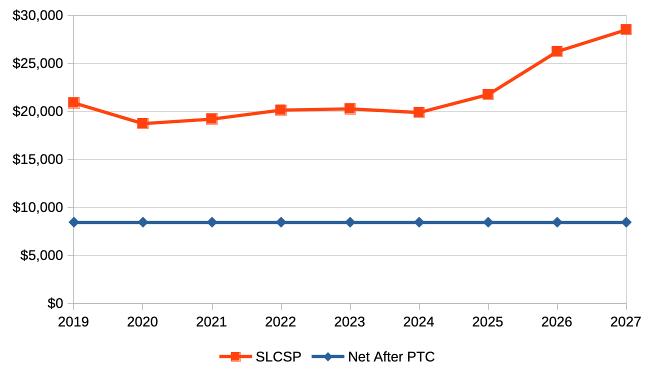
I adjusted everything by the applicable Federal Poverty Level each year, which itself is adjusted for inflation. I’m only showing the effect of the current law, as if it were in effect between 2021 and 2025 (ignoring the enhanced subsidies during those years).
The red line shows the full annual price of the Second Lowest Cost Silver Plan (SLCSP), which is a benchmark in ACA health insurance. The blue line shows the net cost after the premium tax credit (PTC) for a two-person household with an income at the cliff. Households with income below the cliff pay less. The net cost is flat after adjusting for inflation because it’s set to a percentage of income.
Premiums were relatively stable in the first several years. Then they started taking off in 2025. The increase in 2026 was twice as big as in 2025. 2027 will be a third year of large increases. The cumulative increase over these three years is 43%. Because everything in the chart is already adjusted for inflation, these increases are above and beyond general inflation.
This phenomenon isn’t unique to my area. KFF reported that the median proposed premium increase from insurers nationwide was 15% for 2027 after a 20% increase in 2026. Some places may have had smaller increases, and others may have had larger increases than my area.
Premium increases in my chart come from two sources. One is normal aging. The other is health insurance prices rising faster than general inflation. Healthcare costs more over time because we’re more prone to health problems as we age. Why premiums have substantially outpaced general inflation is a debate for economists and policymakers. This post is about what we can do in the face of large premium increases.
Effect of Premium Increases
Premium increases affect two sides of the cliff very differently.
Benchmark Plan
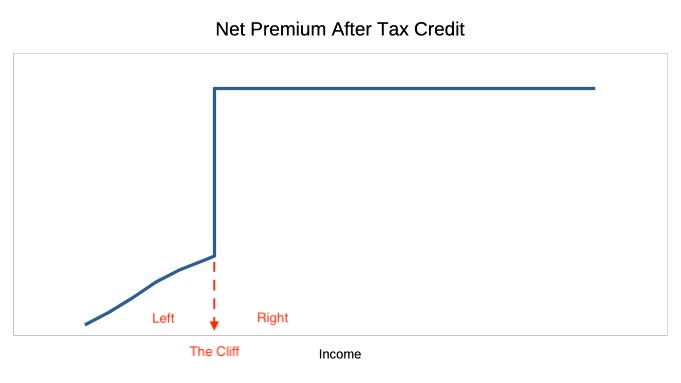
When your income falls on the left of the cliff, you’re shielded from premium increases in the benchmark plan. Your net cost after the premium tax credit is capped at a percentage of your income. If the premium doubled, your net cost would still stay the same as long as your income doesn’t change (after adjusting for general inflation).
The right side of the cliff doesn’t have that shield. You’re completely exposed to premium increases. Even if you can afford the full price today, it can become a problem down the road.
Bronze Plan
My wife and I have always used a Bronze plan because we’re relatively healthy. Bronze plans have lower premiums but high deductibles and high out-of-pocket maximums. All Bronze plans are HSA-eligible now. The plan we most likely will choose for 2027 has a $13,800 deductible and a $24,000 out-of-pocket maximum. We don’t expect to come close to meeting the deductible.
The chart below shows our plans’ annual prices over the years.
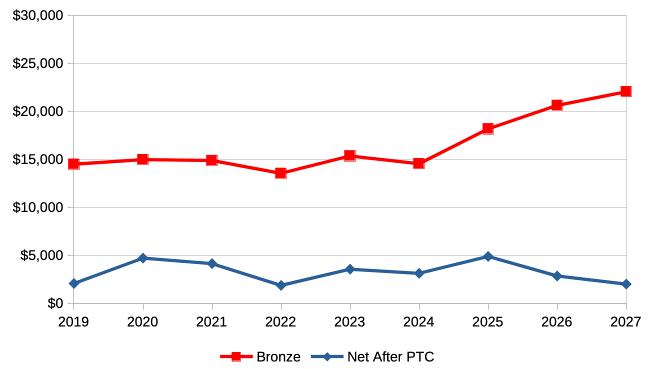
The red line shows the full price. The blue line shows the net cost after the premium tax credit for a two-person household with an income at the cliff. Again, I adjusted everything for inflation.
Bronze plans cost less than the SLCSP. Their premiums had a similar pattern. They were relatively stable through 2024. Then there were consecutive large increases in 2025, 2026, and now 2027. The cumulative increase over three years is 52% on top of general inflation.
People on the right side of the cliff are fully exposed to these large increases. Choosing a Bronze plan saves some money initially, but prices can still escalate much faster than general inflation.
Price Gap Fluctuations
People receiving a tax credit while using a Bronze plan are rewarded for choosing a less expensive plan. The net premium formula is:
Percentage of Income – (Full Price of SLCSP – Full Price of the Bronze Plan)
You pay the price difference when you choose a more expensive plan than the SLCSP. The net premium formula is:
Percentage of Income + (Full Price of the Selected Plan – Full Price of SLCSP)
The component in the parentheses, i.e., the price difference between the SLCSP and the selected plan, isn’t stable. When the full price for your selected plan increases more than the SLCSP, it can raise the net annual premium from $2,000 one year to $5,000 the next year in this example. However, we’re talking about lower total dollar amounts here. Whether it’s $2,000 a year or $5,000 a year, it’s still much more affordable than paying full price.
The price difference doesn’t necessarily change only in one direction. The net annual premium can drop back to $2,000 in another year when the full price for your selected plan increases less than the SLCSP.
Learnings for Early Retirees
Examining 9 years of premium history shows that the same large premium increases land very differently depending on where your income falls.
If your income falls on the left of the cliff, the premium tax credit absorbs most of the increases. After adjusting for general inflation, if your income stays the same, your net cost for the SLCSP in 2027 would be the same as in 2019, even though the full price rose sharply. The net cost for a Bronze plan swings from year to year as the price gap between the SLCSP and Bronze plan changes, but it stays far below the full price.
If your income falls on the right of the cliff, you don’t have such protection. Anyone paying full price is hit by the increases directly.
Know Your Cliff
The cliff is a hard cutoff. You must know where the cliff is and what counts and doesn’t count toward the cliff.
Increases MAGI
- Pension
- Wages, self-employment
- Deferred comp plan distributions
- Rental income
- Interest, dividends, capital gains
- Tax-free muni bond interest
- Pre-tax 401k and IRA distributions
- Roth conversions
Decreases MAGI
- HSA contribution
- Pre-tax 401k and IRA contributions (if having earned income)
- Self-employed health insurance and long-term care insurance
- Capital loss
- CD early withdrawal penalty
No Effect on MAGI
- Standard deduction
- Itemized deductions
- Donations to charities
- Spending after-tax principal
- Qualified withdrawals from Roth accounts
- Spending borrowed money
Track your income throughout the year and leave a cushion below the cliff. Don’t let a surprise year-end dividend or capital gain distribution blow you over. Choosing a Bronze plan and contributing to an HSA lowers your MAGI for ACA. So does making pre-tax 401k and IRA contributions when you have earned income. My tax calculator for retirees shows how far your income is from the cliff.
Retiring After 60
If you’re retiring after 60 and you’ll use ACA health insurance for only a few years, you can delay Social Security, set aside cash in an after-tax account, and withdraw from Roth accounts during those years. In some cases, it even makes sense to borrow from a HELOC or a securities-backed line of credit for a couple of years (please read the linked article for details). Spending after-tax cash, qualified withdrawals from Roth accounts, or spending borrowed money doesn’t increase your income for ACA.
Retiring Much Earlier
If you retire much earlier and expect to use ACA health insurance for many years, you need a plan to keep your income on the left side of the cliff. Self-employment, Social Security, interest and dividends, Roth conversions, withdrawals from pre-tax accounts, and realizing capital gains all increase your income for ACA. Keeping them low during years you’re on ACA health insurance will help. You can convert to Roth or realize large capital gains in years either before you get on ACA health insurance or after you get off.
If you can’t keep your income on the left of the cliff for the entire duration until you’re 65, it’s more important to land on the left in later years than in earlier years because premiums go up over time.
You can also bunch your income. If you must go past the cliff, go over big in one year to bank the money for the next several years. Spending banked money in subsequent years can help because it doesn’t add to your income.
Large premium increases above general inflation create challenges when you retire before 65. You can protect yourself from these increases by managing your income to the left of the cliff. Make a plan, track your income, and leave a cushion.
Learn the Nuts and Bolts
I put everything I use to manage my money in a book. My Financial Toolbox guides you to a clear course of action.
Paul Collinson says
Well done, Harry. Really helpful and understandable. The graphs simplify. Much appreciated.
KJ says
Thank you Harry.
We live in Oregon and I retired in my mid 50s in early 2024. In 2025 got a silver ACA plan for the 4 of us using the enhanced subsidies at $1142 a month. Wasn’t bad and liked the coverage. This year it was just my wife and I, for a bronze plan, at $1555 a month (at $7500 deductible per person). Unfortunately we ended using most of the money we put into the HSA account. I think overall for premiums, HSA and other expenses we ended up spending about $32k for the year. It was steep but c’est la vie.
Next year, from the looks of it, we will go with a silver plan at $2264 per month ($6k deductible per person). So about $27k total cost for the year. Since it has copays I think we will end up spending about $32k (maybe 33k) total. So the ACA rate went up but the total cost is about the same for 2027.
Unfortunately (or fortunately?) there is no way to get under the cliff. I tried to work it out but no way. Unfortunately for next year, it’s going to be about 25% of our net income 🙁
Thankfully we can pay but long term feels exhausting.
John Snider says
So 25% or 10% is cost to live in the USA now if you want health insurance? 25% for those that pay higher because higher income? and 10% for those that pay less because under the target limit?
Harry Sit says
It can be more than 25% or less than 10%. You can check the specific percentage for your location, household size, and income by looking up prices on healthcare.gov or the ACA exchange for your state. Use the “Browse plans and costs” option or something to that effect. Try different incomes and see how prices change.
Mark Haren says
Thank you for the very informative article. I’m wondering if you have thoughts about the cliff once one person reaches Medicare while the spouse is several years younger. Is it worth it to continue the cliff game?
Harry Sit says
The tax credit will be lower after one person reaches Medicare. I tested it both ways for my area. A couple, ages 59 and 64, receives $22k in premium tax credit when their income is at the cliff. Another couple, ages 60 and 65, covering only the younger spouse, receives $6,600 in premium tax credit. They can decide whether that $6,600 is worth pursuing by lowering their income to the cliff.
You can do the same tests for your area to see how the numbers look.
Allan says
I wonder how long it will be before the government starts using some sort of Roth withdrawal scheme for ACA income calculations. It’s too big of a pot of money for our legislature to ignore.
Harry Sit says
I think that’s quite possible. If they include Roth withdrawals only in the MAGI definition, they can still say they haven’t reneged on keeping Roth accounts tax-free.
Erik says
Perfect timing with open enrollment commencing. I agree with everything you said. I just have one comment given I am at the age of 55 on a coveredca bronze plan about the same amount of time as your analysis. Yes, the premiums are rising due to both age increasing and health care cost(s) increasing above general inflation, no disagreement, however, you forgot to include the increased deductible year over year. the bronze from five years ago approx $6,800 annually for a single person such as myself to year 2027 $7,800. so that’s approx another 15% increase in the last five years. When you don’t include this adjustment factor you are missing a significant cost increase which most people don’t observe.
erik says
Harry said “I think that’s quite possible. If they include Roth withdrawals only in the MAGI definition, they can still say they haven’t reneged on keeping Roth accounts tax-free.”
Please don’t give elected or unelected politicians any free ideas. This is an absolutely worst case idea. this would be a double or triple tax? So you pay FICA, you pay federal tax, you pay state income tax, then you contribute to a roth IRA, then you are subjected to obama care premium tax credit exclusion? that change in tax treatment for early retirees would be a global death sentence for Roth IRA accounts for everyone and anyone.
erik says
Hi Harry, a post separate from the above discussion on ACA involving a hypothetical example if you are currently eligible for Medicare currently during open enrollment before its ends on December 7. Would you do Medicare Advantage (MA) or Traditional Medicare with a supplement plan like plan “G”. What about part “D” prescription drug coverage. You get a restricted network with MA, but an unlimited network with traditional Medicare with plan G as a supplement. I would like to hear the feedback from your readers and how they balance the pros and cons upon age 65?
Harry Sit says
I’m not at that age yet, but I would lean toward Traditional Medicare with a supplement when the time comes. Healthcare becomes more important as I get older. It’s worth spending more. I would choose a drug plan based on my usage at that time.
KD says
Harry, Thank you for the excellent article. Very helpful perspective. What do you think of catastrophic plan as a backup for the years you know you will go above the cliff if available? Say I know I plan on bunching my income next year and give up subsidy next year so that I am eligible in subsequent years. Then researching catastrophic plans – both on-exchange (Court has blocked it for all nationwide based on an injection in a case in Maryland) and off-exchange (they will not be labeled as such off exchange) is part of the exercise I think. One has to be proactive to do the research and find out what is available. This is dependent on state laws regarding eligibility and plan offerings in particular zip codes. I find found the the network coverage is the best for these plans vs any metal offerings in my zip code. The trade off is a very high deductible. This is not a bad thing in my book. This is how insurance is supposed to work vs first dollar coverage that jacks up prices of plans in my opinion.
Harry Sit says
It’s worth looking into off-exchange plans when you’re paying the full price anyway. Just make sure it’s not a short-term plan that excludes pre-existing conditions. Using a health insurance broker may help.
Availability varies by area. After Medicare, Medicaid, CHIP, employer plans, and ACA plans, the addressable population pool for separate off-exchange catastrophic plans becomes quite small. The two major insurers in my area only sell short-term plans and the same ACA Bronze plans at the same [full] prices off-exchange. They don’t bother creating another plan.
David says
Harry, thanks for your many posts regarding the ACA over the years. For someone looking to qualify every-other-year by using income bunching, it seems to me in a designated low income year (Year 1) it could useful to “forget” to take a portion of the RMD during the year. And then take the missed RMD in Year 2, a designated high income year.
My understanding is this portion of the RMD would be included in Year 2 AGI, and not in Year 1 AGI. There would be a 10% penalty payable for missing the RMD in Year 1, but that could be a small price to pay for qualifying for the PTC in Year 1. E.g., under-withdraw $5,000 in Year 1, then withdraw it in Year 2 and pay the $500 penalty. That could be well worth it if it allowed you to claim a PTC of 5,000+ in Year 1.
Do you think this works?
Harry Sit says
RMD age is 73 and older. ACA health insurance is for people under 65. If you’re talking about a married couple with one spouse over 73 and the other under 65, note that the cliff isn’t as high when you use the joint income to cover one person on ACA (see my reply to comment #3). If RMD is the only source of income you can control, and withdrawing $5,000 less will keep you under the cliff, sure, that can work. If you’re withdrawing an additional ammount on top of RMD, withdrawing twice the amount in one year and nothing next year will work. It just depends on the composition of the income and which component you can change.
David says
Oh, I probably should have mentioned in my particular situation I am considering under-withdrawing from an INHERITED IRA which was somewhat unexpected this year. That RMD is the only remaining degree of freedom I have. Thanks for confirming this should work.
Dave S. says
Your net cost after the premium tax credit is capped at a percentage of your income. If the premium doubled, your net cost would still stay the same as long as your income doesn’t change (after adjusting for general inflation).
—
Really appreciate this timely post!
As another data point, here are my premium numbers for the same plan:
2026:
before-subsidy ~$1700
after-subsidy ~$240
2027:
before-subsidy ~$2120
after-subsidy ~$470
The before-subsidy premium surged ~25%!
My net cost (as a percentage of annual income) has doubled from 8.5% to 17% even though my income doesn’t change. I’m not sure what you mean by “your net cost would still stay the same as long as your income doesn’t change”
Also, Harry, how much are you paying for Dental insurance?
Do you choose a Dental policy from ACA or somewhere else?
Harry Sit says
If $470/month is 17% of your income, your income is about $33k. If you’re single, you should pay about 7% of that income, which is about $200/month, toward a benchmark Second Lowest Cost Silver Plan (SLCSP). If the full price of the SLCSP doubled, you would still pay the same $200/month for it. The plan you chose has become a lot more expensive than the SLCSP. That’s the effect of “price gap fluctuations” I mentioned in this post. You pay more when the plan you choose goes up more than the SLCSP. You pay less when the plan you choose goes up less than the SLCSP.
I pay about $100/month to cover two people on a Delta Dental PPO plan. I bought it directly from Delta Dental (available in AL, CA, DE, FL, GA, LA, MD, MS, MT, NV, NY, PA, TX, UT, WV and DC).
BN says
I recently came across plans marketed by some healthcare brokers that are “employer” plans wherein you become an employee by drawing a $10 salary per quarter.
Example companies are lifex research, bright life research etc.
The premiums are about half of the ACA premiums for a similar deductible/copay and seem to have big name networks like Cigna.
The catch –
These plans seem to be self funded and geared towards the healthy with very less usage of the insurance. Kind of like the catastrophic plans.
Some claim to be ACA compliant and do not exclude pre-existing conditions. Not sure how much compliant as they are not the official exchanges.
If you start using the plan/benefits heavily, perhaps the company will “lay you off” and terminate the insurance ??
Any other thoughts on these type of insurance ?
Harry Sit says
I haven’t heard of these. They sound too clever to me. I certainly don’t want to be “laid off” when I have an episode of claims.
Doneat57 says
I just retired this year at 57. Planning for ACA has taken more time and energy than any other element of detailed retirement planning and the tools out there (Boldin, etc. offer little to no help with this).
I thought I understood ACA back in 2023 when I really started to plan to quit my job – but in reality I knew the rough bones of the thing. I’d have done things differently if I’d understood better.
1. I participated in a deferred compensation plan for my last 3 years where extra money was held out (pre-tax) to be paid out later. I scheduled payments to be disbursed over 5 years (get me to social security age I was thinking – though I plan to wait until 65 at least). Problem is that results in about $50k/year of ordinary income with $10k+ of interest and dividends on top of that, leaving little room for using LTCG to reach our target spending level. (A good problem to have, but it increases healthcare expenses by close to $20k/year, eating up more of the budget the housing, utilities and food combined.)
2. We had planned to leverage a Bronze plan and HSA – but I hadn’t looked at the deductibles and out of pocket maximum. My employer plan was a HDHP plan with a deductible of $5400 and out of pocket around $7500 – I made the bad assumption a Bronze plan would be similar, but it was closer to the numbers you listed. That’s a no-go for us, because my wife does have some health issues (cancer, thyroid issues, etc.) that means we sometimes do hit our out of pocket maximum.
3. I have very little (less than $5k) in Roth, so my ability to control taxable income/MAGI relied a lot on LTCG * HSA. I would have done some backdoor Roth conversions but didn’t think I needed to, especially at my current tax rate.
Once I learned the details, I had to alter my plan. This year and 2027 I’ll stay on cobra ($2200/month) – and do Roth conversions up to the top of the 24% bracket. Depending on what happens with ACA tax credits, I may go with a full cost Gold plan in 2028 and do more Roth conversions or I’ll switch to keeping my MAGI below the cliff – either way, will leverage Roth and HSA early in retirement to reduce MAGI until 65.
This is kind of backwards from the typical withdrawal strategy of leaving Roth untouched for as long as possible, but any kind of shield from the ACA cost increases seems worth that trade off to me.
Great article – I wish I had spent more time understanding ACA before making some of the decisions I did. I wasn’t actually even aware that the “cliff” was a thing – when I was planning, the COVID era provisions were still in place and I didn’t know enough to even understand that that could change – I was listening to high level advice that assumed the cliff would not exist.
Harry Sit says
Thank you for sharing your experience. Many people think they need income in retirement, but they only need cash flow, which isn’t the same thing. In your case, distributing deferred comp in the early years of retirement creates income, but it kills your cash flow flexibility. A large part of the income ends up flowing to health insurance. Creating cash flow by selling investments and realizing long-term capital gains gives you more control.
When you and your spouse have different healthcare needs, you can enroll in separate ACA plans. For example, you can use a Bronze plan and HSA for yourself, and your wife can use a Gold plan. See ACA Health Insurance: Different Plans For Different Family Members. That old post used California as an example. It works on healthcare.gov as well.
tbowman says
Very helpful article. Don’t forget Self-Employed Healthcare Deduction in the Decreases MAGI column. If you qualify and have self-employment income this can be huge because of the large increases in insurance premiums.
It’s a bit of a circular calculation since lowering your MAGI can potentially increase your Premium Tax Credit. A higher subsidy means you paid less out of pocket, which in turn limits or changes your final self-employed health insurance deduction.
Harry Sit says
I added self-employed health insurance and long-term care insurance premiums to the list. However, they’re limited to self-employment income, minus 1/2 self-employment tax, minus pre-tax retirement plan contributions. In the context of early retirees doing some casual self-employment, there may not be any room left after maxing out pre-tax retirement plan contributions to lower MAGI. In some edge cases, though, selecting a more expensive health plan can move a self-employed person to the left of the MAGI cliff.
Steven M Hagedorn says
Remember also the Impact of Self-Employed Tax Deduction on ACA Eligibility
Here’s how It Works:
The self-employed (SE) tax deduction can significantly affect your eligibility for premium subsidies under the Affordable Care Act (ACA). This deduction lowers your modified adjusted gross income (MAGI), which is a key factor in determining your eligibility for these subsidies.
Benefits of Lowering MAGI
A lower MAGI can lead to:
Increased Eligibility: Reducing your MAGI may help you qualify for premium subsidies if your income is near the threshold.
Larger Subsidies: A lower MAGI can result in larger premium subsidies, making health insurance more affordable.
Key Considerations
Self-Employed Health Insurance Deduction: This deduction allows self-employed individuals to deduct health insurance premiums, which directly lowers MAGI.
Income Thresholds: For 2026 and beyond, the ACA subsidy eligibility is limited to those with a MAGI not exceeding 400% of the federal poverty level (FPL).
Utilizing the self-employed tax deduction effectively can enhance your chances of receiving premium subsidies under the ACA, making it crucial for self-employed individuals to consider this deduction when filing taxes.
Harry Sit says
Some early retirees engage in part-time self-employment. The best way to reduce the impact of that self-employment income on the ACA MAGI is through pre-tax contributions to retirement accounts. The 1/2 self-employment tax deduction happens naturally. Tax software calculates it automatically. You don’t have to do anything to “utilize” or “consider” it.
SLK says
Regarding charitable deductions, doesn’t the new law allow $1,000 for singles and $2,000 for a married couple to be deducted above the AGI line for 2026 and 2027? Cash contributions only, not “stuff”.
Harry Sit says
It does, but the deduction is below the AGI line. See $1,000 Charity Donation Deduction in the 2025 Trump Tax Law and Tax Deductions: Above-the-Line, Itemized, and Neither.
Butch says
I live in NC and 2027 will be the third year on ACA for us utilizing the subsidies. Your chart shows the premium (after PTC) in the bronze plan declining in 2027. Our premiums have gone up more than 50% in 2027. We are paying $250 per month for two people in 2026 and will be paying over $500 per month in 2027. Inflation alone can’t explain away such a large increase. In my case the blue line in your chart would be going up steeply.
Harry Sit says
Relative price changes between the SLCSP and your Bronze plan caused that. You can look up the full prices of the SLCSP (filter for Silver plans, sort by premium, and look at the second-lowest) and the full prices of your Bronze plan for both 2026 and 2027. The SLCSP may not be the same plan in both years. Your net premium goes up steeply when the price of your Bronze plan increases more than the price of the SLCSP. It can also drop steeply when the price of your Bronze plan increases less than the price of the SLCSP. That’s the effect in the “price gap fluctuations” section.
erik says
I am reading these comments and I realize people do not do their homework in advance.People, do your homework and avoid all of these listed problems.
Floyd says
Great stuff Harry. Question: re magi calculation, my understanding is if you have a dependent child, such income is ignored UNLESS its considered material (someone said 15k or more but nobody seems to know for sure and none of calculators contemplate it, not even yours). She a college Sr doing part time work for her future full time employer. Say her wages for ’26 will be 18k and material means 15k, then does this dependent get her magi contribution reduced if she makes an IRA contribution of say 7k (and can I fund the 7k)? So when I add her magi contribution to my interest & divs when estimating for ACA, I add 11k in this instance as her contribution? Or maybe I add zero because she is now below trigger level of 15k? This could be crucial when at or about the cliff!
Harry Sit says
My tax calculator for retirees includes a line for “MAGI from tax dependents required to file a tax return” in the ACA section. The tests are (a) whether you can claim your daughter as a dependent on your tax return; and (b) whether she’s *required* to file a tax return.
The IRS has a list of requirements for when you can claim someone as a dependent on your tax return. A key test is providing more than half of their financial support. If you can’t claim her as a dependent on your tax return, you have two households sharing one ACA policy. Each household has its own cliff based on its size. You allocate the premiums and any advance subsidy between the two households.
If you can claim her as a dependent on your tax return, you have one larger household with a higher cliff threshold. The next test is whether she’s *required* to file a tax return (not whether she actually files one). The IRS has a full write-up (scroll down to find the “Dependents” section) and an interactive tool to determine whether a dependent is required to file a tax return. The dollar thresholds for this determination are based on gross earned and unearned income. Contributing to an IRA doesn’t affect the gross income. The $15,750 number on those pages for 2025 has increased to $16,100 for 2026.
Finally, if you can claim her as a dependent and she’s required to file a tax return, you must include her MAGI. Contributing to a Traditional IRA lowers her MAGI, as it does for anyone else. You can gift the money, but she’s officially contributing $7,500 to her IRA. She’ll claim it on her tax return.
Floyd says
Thanks Harry- I didn’t catch u have that line item. I cover most of her expenses but out of a 529. I think for 26 she will need to file and also I’ll claim her as dependent. I think u r saying in this case her contribution to “family magi” in 26 will be 18k wages minus 7k IRA = 11k—- not zero and not 18k
Harry Sit says
The MAGI calculation is the same for everyone. Anything that lowers MAGI also lowers her MAGI. If she’s paid on a 1099, she can set up a solo 401k or SEP-IRA and contribute more to her retirement accounts.